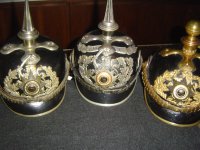
I paid $450.00 for my Hessian L G I R 115 officers helmet back in the 1970's
A helmet from that regiment is now $7,000 +
Steve
I am not picking on Steve here for saying this, because what he said is true.
A rare $450 helmet back in the 1970's that is now valued at $7,000.
$450 was a lot of money back in the 1970's to most people.
Here is a part of the understanding of how this happened:
In 1965 the United States made the decision to discontinue silver coins.
Right now, $1 face value of silver U.S. coins made before 1965 are selling for a bit over $30.
Currently, 99% pure silver, one ounce, $1 face value 2025 minted U.S. Silver Eagle Coins are selling for over $41 per coin + "spot".
Gold is currently at $3,600+ per ounce. A year ago in January of 2024, it was far less than half that amount. If I recall correctly, around $1,200 or so per ounce. I would need to check to make certain the exact value amount per ounce of Gold in January of 2024. That huge increase in price/value per ounce speaks as to how bad our inflation problem is.
And in 1933 gold U.S. coins were discontinued. This was necessary so that the USA could inflate its currency.
Inflation destroys the value of the U.S. Dollar over a period of time, making things much more expensive to purchase.
For instance, inflation in 2023 began with monetary policy mistakes in 2008, when then–Federal Reserve chair Bernanke embarked on a new, untried policy called Modern Monetary Theory (MMT). The Fed issued — “printed” — trillions of U.S. dollars and inserted them (liquidity) into the economy. It is called quantitative easing, or Q.E. This was an extreme departure from historical policy, and it was implemented unilaterally and without debate by the Treasury Department and the Federal Reserve. They did Q.E.1, Q.E.2, and Q.E.3.
U.S. Federal Reserve implementation of a new monetary theory (MMT) in 2008 haunts us to this day. The inflation we suffered over the bulk of President Biden’s term was caused by excessive money supply that started in 2008. Any fourth-year economic student (or a first-year Austrian School economist) would tell us that excess money supply causes devaluation of the purchasing power of the U.S. dollar — in other words, inflation.