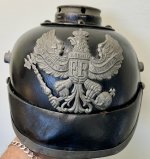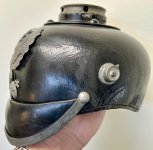

Prussian M15 Tschapka

b.loree

Administrator
Staff member
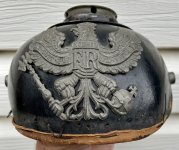
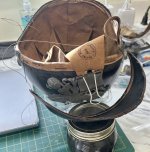
Another project has arrived. Here are the "before" photos:
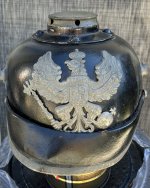
IMG_4328.jpeg
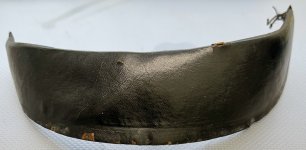
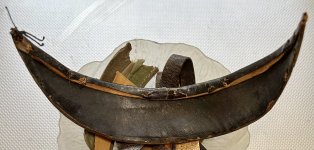
As usual, the visor needs to be restitched. The wappen is unique to these lancer helmets....notice the meeting of feathers beneath the FR. The visor trim also has problems due to years of environmental abuse effecting the leather. The size here is 56 cm.
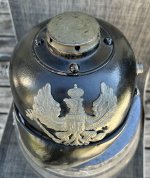
IMG_4329.jpeg
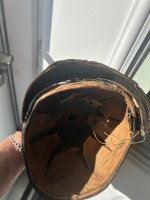
The angle of the bent trim/visor suggests that the piece lay on it's side for a century.
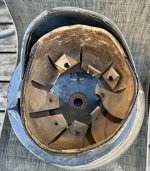
IMG_4331.jpeg
We are going to take an in depth look at tschapka construction in future posts here.
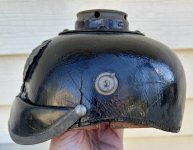
IMG_4332 2.jpeg
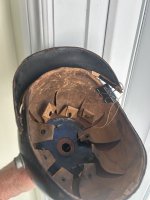
Unfortunately, we have a crack in the shell here caused by the trim split brad. More to come.
 
Last edited:
Very curious and excited to see your skills again Brian..for this is one of my favorite helmets and hope this one comes out fantastic as well.. 👍
 
No Rob, securely hand stitched with thick black thread. :) As the tschapka has a unique construction, I am going to post some close up pictures illustrating this. Bruno is correct, there is only one way to, stitch this and it takes two pairs of hands. Fortunately, my wife has helped with the other 3 of these that I have done in the past. 👍 So, lets take a closer look at this piece:
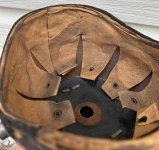
IMG_4366.jpeg
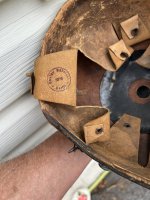
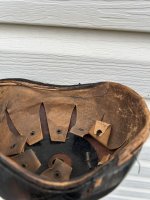
First, the liner...the tapered tips are folded over and then grommeted for a thin leather lace or string, missing in this case. We can also see by the lack of scratches on the black support disc that the top has never been removed. Looking at the back of the shell we see a thin strip of "cane/reed" which is is stitched along the rim of the helmet. The ends of the liner are stitched together like a normal pickelhaube and we see a period repair done where the liner tongue tore during manufacture.
IMG_4373.jpeg
It is unusual to find a manufacture stamp on the flesh side of the liner. Gustav Robrich (?) Berlin, 1916. There is a similar stamp on the inside of the shell next to the size (56) stamp.
IMG_4367.jpeg
The reed with its fine stitching stops at the brow of the helmet.
IMG_4369.jpeg
A shot of the front edge of the liner where it is tack stitched to the front edge of the tschapka. With a closer look, we can also see the large visor stitch holes and the remains of the heavy thread used to secure the visor.
 
The front visor is also more complicated than that of a pickelhaube.
IMG_4377.jpeg
First, an outside view....the visor is not shellacked. It has a thin pebbled leather covering.
IMG_4375.jpeg
Interior: The visor is 3 piece construction, a central core sandwiched between two layers of thin pebbled leather which are glued to it and folded over along the top edge.. The core itself has to be made from thinner gauge leather than the usual pickelhaube visor. One of the previous tschapkas that I stitched, had black paper glued to the inside surface. To be continued...
 
I have started to work on the tschapka. In one way, the restitch is easy as it only requires one pass along the front of the helmet and there are only 6 large stitches. The hard thing is that you can not cinch up the thread tight to the shell. The thread needs to be loose and as a result, the visor flops around continuously as do the fingers of the liner. To compound this, the thin fold of leather which is stitched to the shell often needs repair as on this piece. Originally in 1915 when this was made, we have new pliable leather to deal with. The visor is held vertically and the thin leather flap is hand stitched to the shell. When complete, the visor is pulled down into the correct position and the stitches are hidden. The trim is then put on holding the visor in place. The "look" is fashionable and sheik but the visor is not sturdy. Some photos of the process so far:
IMG_4428.jpeg
I have the first stitch done. I am using"gimp thread" NOS made in 1952! I bought 2 spools from Great War Militaria decades ago. :) You can see what a "pain" doing this is. This thread roughly matches the thickness of the original. My thread has been heavily waxed as I will be totally screwed if it will not pull through each hole when I cinch up the visor to the shell! :oops:
IMG_4440.jpeg
Not the best of photos but you can see how the thread must be left loose or else you can not access the original holes in the visor flap and shell.
IMG_4438.jpeg
Typically, one of the stitch holes in the visor flap has pulled through so a thin leather patch has to be glued on to fix this. You can see just how thin (2 layers) this flap is.😐 It is thin because it has to be folded down into position. A third part of the difficulty here, is that your thread has to be pushed down into the fold as you go along to the next set of holes. A good set of pointed tweezers is a must! You can also see the thin leather patch that hopefully will permit me to put thread in that hole. Last, note that as usual, I am doing this on a bright sunny day, you can not beat "natural" light! :) To be continued.....
 
Last edited:
I finished the visor yesterday:
IMG_4483.jpeg
The waxed thread cinched up fine without breaking and the visor is now firmly attached to the shell. There is a gap on the left side but after 110 years of environmental exposure, this is as good as it gets. Some additional "fixes"....the visor trim was straightened and the 2 layers of thin leather along this outside edge had to be re glued so that they did not catch and tear as the trim was put back on.
IMG_4484.jpeg
The piece does not have to be mailed until Nov 17, so in the meantime I will keep adding some finish to this crack in the shell. The shellac has the consistency of water so I will hit this with shellac at least 2-3 times a day. :) In the end a light application of black shoe polish should hide this. These pieces of headgear were quite stylish in their day.
 
Oooh lala looks very chic!
I am curious, did you use glue or filler on that side crack first or are you just layering it with shellac? You reminded me I have a split crack on my tchapka crown that needs some aesthetic improvement.
Side note/tip: In sword grip restoration I have used matching color non-hardening wood filler to fill small holes and cracks in leather. Also black milliput is excellent filler and adhesive but it dries rock hard. Then a thin layer of Howard's leather restorer or beeswax and buff to even out.
 
No glue or filler in the crack. The backing strip inside was glued but nothing outside. At present I am layering shellac into the crack to fill it in. Regarding shellac, I am trying Wojtek's method of melting original flakes of finish with 99% isopropyl alcohol. This is what is being applied on this piece and another M15 helmet that I own. So far on the M15, I am finding that the melted shellac remains "tacky" even days after application. We shall see...
 
Back
Top