
Carl Zeiss Binoculars

Steve Nick

Well-known member
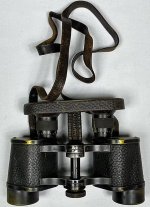
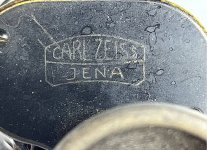
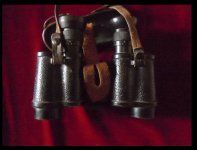
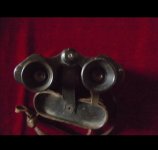
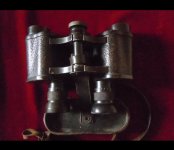
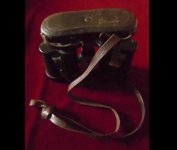
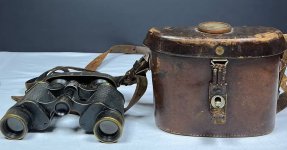
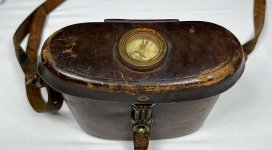
I just purchased this pair of Imperial Army binoculars made by Carl Zeiss at an estate sale in Ottawa.

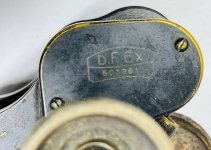
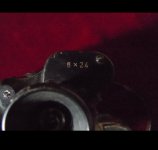
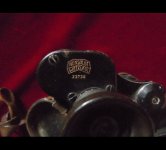
Based on the serial number and the materials used it’s most likely these were produced around mid-1915. This is a D.f. model in the very popular 6 X 30 version.

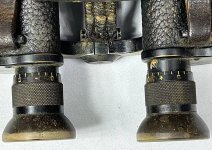
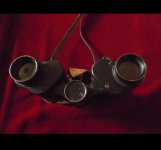
The optics are really surprisingly effective considering they are 111 years old. Good examples of binoculars of this quality in their original carrying case along with carrying straps and the “raincoat” (used to keep water out of the ocular lenses) with its spring tensioner are hard to find these days.

The left Objective lens features a range estimating reticle which I don’t now how to use at this point.

Its only flaw is the compass built into the case cover which features the ability to freeze the bearing has a hole in its glass lens.

I have had a pair of WW2 Binoculars made by E. Leitz/Wetzlar in 6 X30 for many years as they were given to my grandfather by a Canadian vet so I’m quite happy to have an Imperial pair by a maker on a par with Leitz as a companion piece.
Carl Zeiss Jena D.F. 6x WW1 Compass Binoculars 1.jpgCarl Zeiss Jena D.F. 6x WW1 Compass Binoculars 2.jpgCarl Zeiss Jena D.F. 6x WW1 Compass Binoculars 5.jpgCarl Zeiss Jena D.F. 6x WW1 Compass Binoculars 7.jpgCarl Zeiss Jena D.F. 6x WW1 Compass Binoculars 8.jpgCarl Zeiss Jena D.F. 6x WW1 Compass Binoculars 9.jpg
 
The reticule is used to help a artillery forward observer do corrections. Normally to shift fire left or right. The add or drop corrections were estimated visually as well back in the day. So if you looked through and had your centre of the reticle on the target and the round is to the right of the target you would give a "left" correction. The reticle shows you how much of a correction to give. Then add or drop (if the impact is plus or minus of the target.

My first fire mission in the Para Battery when I was a Second-Lieutenant was given to me by my very demanding Battery Commander (BC) who then put the pressure on right after the round impacted. A bit flustered I did a small correction even though I thought it was on target. I then had to correct back after the next round and brought it back. My BC then told me I had "got lucky with my grid" and had had a target round. Personally I don't think I got lucky, had just done a good job. In those days both the BC and Commanding Officer of the Regiment had very high standards and the drill was that you had to give your correction before you lowered your binoculars. The firing battery would give a time of flight and your technician would say "splash" when the round was five seconds out and you would raise your binoculars and be ready to do your adjustment. Loads of fun!

Sorry for morphing this into an Artillery lesson but could not help myself.

Great binos!
 
Last edited:
This is my pair. No reticles unfortunately in mine.
 

Attachments

  • Screenshot 2025-07-01 at 20.08.09.jpeg
    Screenshot 2025-07-01 at 20.08.09.jpeg
    69.7 KB · Views: 3
  • IMG_6011.jpeg
    IMG_6011.jpeg
    67.8 KB · Views: 3
  • IMG_6010.jpeg
    IMG_6010.jpeg
    77.6 KB · Views: 3
  • IMG_6009.jpeg
    IMG_6009.jpeg
    78.1 KB · Views: 3
  • IMG_6008.jpeg
    IMG_6008.jpeg
    74.1 KB · Views: 3
  • IMG_6007.jpeg
    IMG_6007.jpeg
    88.7 KB · Views: 2
  • Screenshot 2025-07-01 at 20.08.42.jpeg
    Screenshot 2025-07-01 at 20.08.42.jpeg
    52.5 KB · Views: 3
The reticule is used to help a artillery forward observer do corrections. Normally to shift fire left or right. The add or drop corrections were estimated visually as well back in the day. So if you looked through and had your centre of the reticle on the target and the round is to the right of the target you would give a "left" correction. The reticle shows you how much of a correction to give. Then add or drop (if the impact is plus or minus of the target.

My first fire mission in the Para Battery when I was a Second-Lieutenant was given to me by my very demanding Battery Commander (BC) who then put the pressure on right after the round impacted. A bit flustered I did a small correction even though I thought it was on target. I then had to correct back after the next round and brought it back. My BC then told me I had "got lucky with my grid" and had had a target round. Personally I don't think I got lucky, had just done a good job. In those days both the BC and Commanding Officer of the Regiment had very high standards and the drill was that you had to give your correction before you lowered your binoculars. The firing battery would give a time of flight and your technician would say "splash" when the round was five seconds out and you would raise your binoculars and be ready to do your adjustment. Loads of fun!

Sorry for morphing this into an Artillery lesson but could not help myself.

Great binos!
Peter:

No need to apologize for the intro to Artillery ranging. I find it quite interesting. In fact, I have somewhere around here a log book that belonged to a gunner in the early days of WW2. I think he was Canadian. It introduced me to the intricacies of long range artillery work taking into account things I had never considered in order to land a shell on a target miles away.

I understand some of the concepts by virtue of sighting in hunting rifles in order to hit a target 300 - 400 yards away, but the workings of Foot Artillery units is on an entirely different level. I must dig out that log book.

I find it interesting that your binoculars don't have a reticle. Does that imply they were made for Infantry use?

My WW2 issue Leitz binoculars have a ranging reticle but on a much simpler basis than these Zeiss glasses. I think I'm on safe ground concluding that these Zeiss binoculars were intended for artillery use?

Thanks for your response.
 
Yes I think they only put the reticle in the binos destined for the artillery so mine would have been for the infantry, etc.
 
Back
Top