
Fuss Artillerie Find

Steve Nick

Well-known member
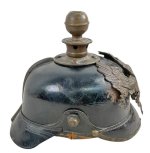
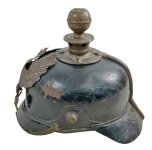
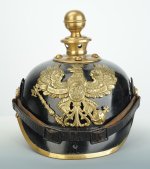
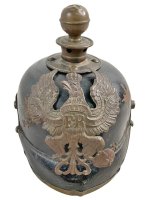
My latest find is this restoration project helmet.

This, to me, is what collecting is all about. It’s gratifying when you can use your knowledge to understand that an item on offer is more than it’s been represented to be. I also enjoy restoring helmets that have been abused over the years.

I found this one right here in Canada so no tariffs and no exchange rate, only a GST of 13% so money saved on that front.

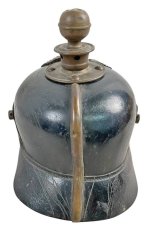
One of the reasons I jumped on this is because I have a FWR cyphered Wappen that has been sitting in the parts drawer waiting for a helmet entitled to wear it. It also has the proper non-vented rear spine for pre-1914 artillery helmets.

Raised in 1864, this regiment wore a white horsehair parade bush and used a Prussian Eagle with the FWR cypher as the Wappen. Only three of the Prussian Fussartillerie regiments wore the FWR cyphered Wappen namely, Nr’s 1, 2 and 6. Why only these three out of the seventeen Line regiments is beyond me.

The damaged Prussian Line Eagle wappen is the 1871 model and only one of the nuts is present. I’ll probably salvage the posts and scrap the Wappen. I think I can straighten the bend in the front visor trim somewhat. I will have to find a period Reichskokarde and a chin strap plus re-lacquer the flaked patches, but other than that the project should be straightforward

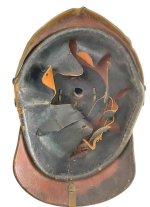
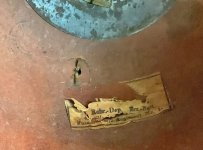
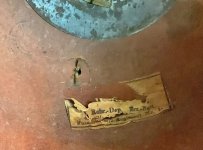
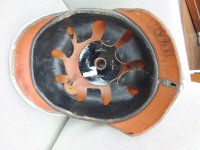
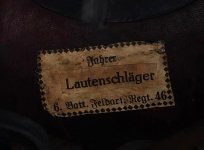
I assume the paper label inside the shell originally had the owner’s name on it but sadly that section of the label has been damaged. I need some help with reading the first word of the top line that is partly legible. The balance of the line is Ersatz Battalion. The bottom line reads” Fussartillerie Regiment Nr. 1”.

Comments are welcomed.
1st Fuss Artillery 1.jpg1st Fuss Artillery 2.jpg1st Fuss Artillery 3.jpg1st Fuss Artillery 6.jpg1st Fuss Artillery 7.jpg1st Fuss Artillery 8.jpg1st Fuss Artillery 9.jpg
 
Any thoughts on the top line of the paper label? R_ _ _ r . Dep. (Depot?)

And, on the far left it looks like a number 4 just to the left of the tear? Possibly 4 R _ _ _ r. Dep. ?
 
What I have been told by A of K is that Fuss have the vented spine while Feld do not. If I am mistaken in this I would appreciate clarification. I have also known Dave for at least 40 years. Nice project helmet. 👍
 
What I have been told by A of K is that Fuss have the vented spine while Feld do not. If I am mistaken in this I would appreciate clarification. I have also known Dave for at least 40 years. Nice project helmet. 👍
The lack of any Kammer Stampings and the paper label with what I assume would have included the owner's name would lead me to conclude that the helmet was a private purchase piece. If that's a valid conclusion then it's possible that the owner was attached to the Rekruten-Depot and not just passing through.

If that's the case it's also possible that when the 1895 pattern helmets were introduced he opted not to upgrade to a vented model.

Should turn out to be a good looking helmet to a better than average status unit for not a lot of work.
 
Should turn out to be a good looking helmet to a better than average status unit for not a lot of work.

Hi Steve,

It's still out there hoping someone feels the same way you guys do.

My kind of project Helmet if I'm being honest is limited to one missing a chinstrap and cockades ;) :cry: I used to be much more ambitious but over the years I've came back to reality.
I'm very happy for and a bit jealous of collectors who have the skills to take on much more then I am. I really love watching Helmets come back to past glories. (y)(y)

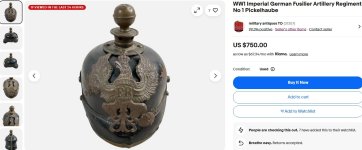
Here is a little free advertising for your friend Dave, he always seems to have a very nice inventory.

fuss1.jpeg
 
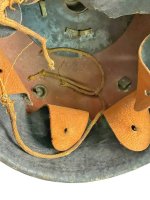
I have the helmet in hand now and there are a couple of peculiarities about it. As I suspected the damaged Wappen is the larger 1871 pattern which never belonged on this 1895 pattern helmet. It will be replaced with the proper sized 1895 pattern Wappen with the FWR cypher. The helmet was manufactured by Gustav Reinhardt of Berlin in 1915.

I've carefully re-glued the paper interior label and you can only see the very bottom edges of the letters of the owners name. What a shame.

I also discovered that the Kugel and base are all one piece. The 1st Fussartilerie was entitled to wear a white parade bush so I'm guessing the original threaded Kugel was replaced somewhere along the line. Fortunately, I have a proper threaded Kugel and base that have been in the parts drawer for years just waiting for a helmet that was entitled to wear a parade bush to come along. You can also see the outline in the lacquer where the interior reinforcing plate was incorrectly installed on the exterior of the shell. Probably at the same time that the current Kugel and base were installed.

I also can see that the helmet was Kammer marked on the rear visor. You can clearly see the rectangular ink stamp but the characters are illegible.
 
Hello,
This helmet marked with an Ersatz-Batterie from 1914, ‘zu Fuß’ should indeed have a ventilation flap on the back of the spine. But it is in fact a Feld-Artillerie helmet available to equip this Ersatz battery in the emergency of mobilisation.
As for the eagle, the FWR is in fact, as for the infantry, the plaque of the ‘old regiments’. This distinction was made in 1860: FWR for the first ‘12’ infantry regiments that became Grenadiers, and also for a few other cavalry or artillery units, as here. It is a distinctive sign of prestige.
 
What I have been told by A of K is that Fuss have the vented spine while Feld do not. If I am mistaken in this I would appreciate clarification. I have also known Dave for at least 40 years. Nice project helmet. 👍
Brian:

You're right about the Fussartillerie having the vented rear spine as they were considered unmounted troops. With the helmet in hand you can make out a faint 1915 stamp inside the dome of the shell, so it should have had the correct spine.

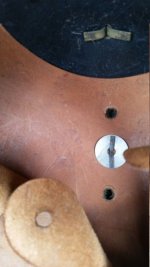
It's also apparent that the rear spine has been changed out at some point. The impression in the leather where the original washer was mounted is pretty clear. The current spine however has obviously been there for many years based on the patina and its interaction with the shell lacquer. I'm going to leave it as is.
 
Hello,
This helmet marked with an Ersatz-Batterie from 1914, ‘zu Fuß’ should indeed have a ventilation flap on the back of the spine. But it is in fact a Feld-Artillerie helmet available to equip this Ersatz battery in the emergency of mobilisation.
As for the eagle, the FWR is in fact, as for the infantry, the plaque of the ‘old regiments’. This distinction was made in 1860: FWR for the first ‘12’ infantry regiments that became Grenadiers, and also for a few other cavalry or artillery units, as here. It is a distinctive sign of prestige.
Clovis:

Being raised in 1864 and being the senior Fussartillerie Regiment as well as East Prussian unit it must have been a forgone conclusion for the regiment to have been awarded the FWR cyphered Wappen plus the right to wear a parade bush.
 
This eagle, known as the ‘old regiments’ eagle, was required by AKO on 6 July 1943 for the regimental insignia (Feld and Fuss):
---1, 3 and 6.
By AKO on 27 August 1843, the two regiments No. 2 also received this FWR eagle in an oval.
PrusseAzF1B1 800€Z2BM15.jpg
N.B. As these regiments are entitled to use the Busch in parade, the balls can be unscrewed and replaced with the Trichter.
N.B. Regiments FAR 1, 2, 3, and A.F. 3, which were entitled to wear the Busch in parade, had balls that could be unscrewed and replaced with the Trichter (source: Lainé).The other four regiments had fixed balls (in theory).

So in 1914, eight regiments bore this eagle:
---1, 2, 3 and 6 FAR (for Feld).
----1, 2, 3 and 6 A.F (for zu Fuß).
On pre-war regulation helmets, the only difference was in the scales and the rear spine.
---FAR: domed scales (mounted troops)
---A.F.: flat scales (foot troops)
---FAR: no ventilation on the rear spine.
N.B. Regiments FAR 1, 2, 3, and A.F. 3, which were entitled to wear the Busch in parade, had balls that could be unscrewed and replaced with the Trichter (source: Lainé).
The other four regiments had fixed balls (in theory).
---A.R.: a ventilation flap approximately 1 cm from the base of the peak and a small ventilation vent under the nape cover.

Jonc AR M91 sans aération.jpg
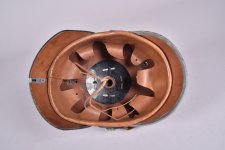
Your helmet has never been fitted with an M95 rear spine for infantry (with ventilation).
In your case, the fastener is in place of the ventilation hole. Here, the washer has simply disappeared, but we are definitely looking at an original hull and a rear spine without an aerator.
This type of non-regulation ‘peculiarity’ can be explained by the urgency and shortage of mobilisation. Often seen on headgear for Rekruten-Depot or Ersatz-Bataillon at the beginning of the war.
This is called ‘Kriegsfertigung’ (including the quality of metals).


For M95 infantry helmets with ventilation flaps:
---Instead of your fastener, there is ventilation, and this fastener is no longer located at the top but more towards the middle of the rear spine.

Garde Artillerie 1 zu Fuß.JPGRondelle sur M15.jpgM15 mint.jpg
 
Last edited:
Your helmet has never been fitted with an M95 rear spine for infantry (with ventilation)
n your case, the fastener is in place of the ventilation hole. Here, the washer has simply disappeared, but we are definitely looking at an original hull and a rear spine without an aerator.
This type of non-regulation ‘peculiarity’ can be explained by the urgency and shortage of mobilisation. Often seen on headgear for Rekruten-Depot or Ersatz-Bataillon at the beginning of the war.
This is called ‘Kriegsfertigung’ (including the quality of metals).

Clovis:

Thanks for taking the time to put together this very detailed response.

It's the willingness to freely share this sort of knowledge that makes this forum so valuable' It's much appreciated, particularly your assertion considering the rear spine. One look at it "in hand" makes it very clear to me that it has been on the helmet a very long time so I think the mobilization scenario is very plausible.

I also appreciate the photo you included of your example. It's a beautiful specimen. I hope my restoration attempt comes somewhat close to your example.

Cheers:
Steve
 
Hello Steve,
I am very happy to share my knowledge and expertise on Pickelhaube helmets. It is the result of more than 50 years of passion, collecting, study and experience! I started collecting militaria at the age of 8 and am now 70.
However, in my long development, I may still make mistakes, so please do not hesitate to point them out, as I am not infallible. (Not to mention any possible mistranslations).
 
I agree, then Ers. Batl. for Ersatz Battalion?? Or battery?

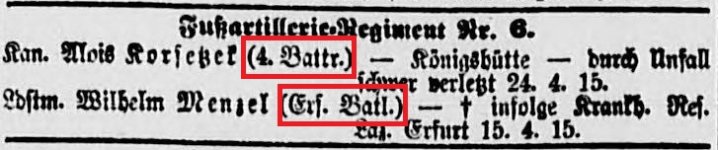
Field artillery regiments were subdivided into two or three Abteilungen. Foot artillery regiments were subdivided into two or three Bataillonen. Most of the time, each of those Abteilungen and Bataillonen comprised three Batterien.
Here, because we are in a Rekruten Depot of a Fußartillerie Regiment, it is an Ersatz- Bataillon (Batl.). Batterie would have been Battr.


ersatzbataillon.jpg

And if we would have had here a Rekruten Depot of a Feldartillerie Regiment, we would have seen a Ersatz-Abteilung.

ersatzabteilung.jpg

Philippe
 
Last edited:
Here, because we are in a Rekruten Depot of a Fußartillerie Regiment, it is an Ersatz- Bataillon (Batl.). Batterie would have been Battr.


Philippe
Thank you for the details, Philippe. I was not sure whether Batl. or Batt. was written on the tag. I have also seen Batterie abbreviated as "Batt".

G1120311.JPG
 
Back
Top