
RoyalScotsVols
Well-known member
Edinburgh, as the capital city of Scotland, has a long history of Militia units which would be too extensive to detail in this short description. The Militia was part-time military service with the members being called out at a time of war or other national requirement. The main distinction between the Militia and the Volunteers (which came into being from 1859) was that the Militia were reserves and could be called up at any time to supplement the Regular Army whereas the Volunteers were intended to be used purely for local Home Defence.
The Militia Act of 1852 and the outbreak of the Crimean War in 1854 gave renewed impetus to organising reformed Militia regiments. In September 1854 the establishment of the Edinburgh Militia was set at 26 officers, 40 non-commissioned officers, 6 drummers and 657 privates in six companies. It was commanded by the 5th Duke of Buccleuch, who was also the Lord-Lieutenant of Midlothian. The regiment was embodied for service on 12 February 1855 and the men were billeted throughout Dalkeith with the officers at the Cross Keys Hotel (I know this building well; it was built in 1804 as a coaching inn. It still exists today although it is no longer a hotel having been converted to residential apartments). The regiment lined the streets from the railway station to Holyrood Palace (the Royal residence in Edinburgh) on 6 September when Queen Victoria visited Edinburgh on her way to Balmoral Castle, and again on her return. As a result, the regiment was given the title 'Queen's Regiment of Edinburgh County Militia', quickly changed to 'The Edinburgh, or Queen's Regiment of Light Infantry Militia'. This rather cumbersome title was usually rendered as the Queen's Edinburgh Light Infantry (QELI). The Crimean War having ended early in 1856, the regiment was disembodied on 28 May. Militia units that had been embodied were not called up for annual training again until 1859, after which it was held every year, the year's recruits attending 14 or 21 days preliminary drill.
Under the 'Localisation of the Forces' scheme introduced by the Cardwell Reforms of 1872, militia regiments were formed into brigades with their local regular and volunteer battalions. For the QELI this was with the Royal Scots (Lothian Regiment) and their permanent staff were increasingly drawn from the Royal Scots. The militia was now under the control of the War Office rather than their county Lord Lieutenants and the officers' commissions were now signed by the Queen. Around a third of the recruits and many young officers went on to join the Regular Army. In 1878 the QELI's headquarters moved from Dalkeith to the brigade’s depot at the new Glencorse Barracks.
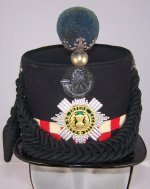
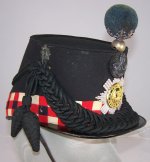
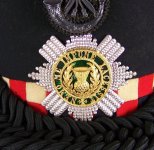
Pictured below is an officer’s shako from the QELI dating from the 1870’s. The shako plate shows a silver Star of the Order of the Thistle and the cross of St Andrew with a gilt thistle within a circlet pierced with the moto ‘Nemo Me Impune Lacessit’ (No-one provokes me with impunity) on a green enamel background. Above the plate is the blackened strung bugle to reflect the regiments status as Light Infantry.
The Childers Reforms of 1881 took the Cardwell reforms further, with militia regiments formally joining their linked regular regiments as numbered battalions. The QELI therefore became the 3rd (Edinburgh Light Infantry Militia) Battalion, Royal Scots in July 1881. On the outbreak of the Second Boer War in October 1899, most of the available regular army was sent to South Africa. Many militia units were embodied to replace them for home defence and to garrison certain overseas stations, while others volunteered for active service. The 3rd Royal Scots were embodied on 5 December 1899 and volunteered for service in South Africa. After an active campaign, they embarked for home on 7 May 1902 shortly before the end of the war and were disembodied on 28 May 1902, having lost 4 officers and 31 other ranks killed or having died of wounds or accidents. The participants received the Queen’s South Africa Medal with clasps for 'Transvaal', 'Orange River Colony' and 'Cape Colony, and the King’s South Africa Medal with the 'South Africa 1901' and 'South Africa 1902' clasps.
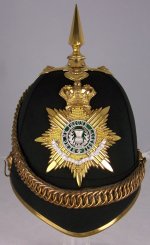
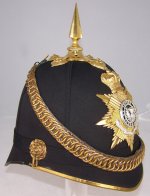
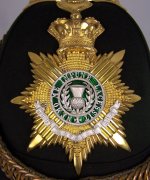
Pictured below is the helmet which belonged to Lt. Col. Mackay John Scobie (brief service details below the photos) who had been serving as a Captain in the QELI at the time of their becoming the 3rd (Edinburgh Light Infantry Militia) Battalion, Royal Scots. Accordingly, this helmet can be accurately dated to July 1881. The helmet fittings are in gilt matching those of a regular officer as was appropriate for this battalion (as opposed to silver for the Volunteers). This style of helmet plate was introduced to the Royal Scots in 1881 and is identical to that for the regular regiment (described in a previous post) except that the title scroll reads ‘The Lothian Regt’ which was worn by the Royal Scots from 1881 to 1891.
Lt Col Scobie initially joined the 42nd Regiment of Foot (The Black Watch) as an Ensign on 12 January 1867 and was promoted to Lieutenant in October 1871. The 42nd played a key role in the Third Anglo-Ashanti War (1873–1874). They were involved in major battles including the Battles of Amoaful and Ordashu, leading attacks and achieving decisive victories for the British under the command of Sir Garnet Wolseley. Four members of the regiment were subsequently awarded the Victoria Cross for their bravery during this conflict.
Lt Scobie retired from the 42nd on 23 July 1878 before being appointed as a Captain in the QELI on 31 January 1879. He was serving at the time of the transition to the 3rd (Edinburgh Light Infantry Militia) Battalion, Royal Scots and was promoted to Major on 26 June 1885. Sadly, he died suddenly on 27 September 1894 at which time he held the rank of honorary Lt Col and was noted as being second in command of the battalion.
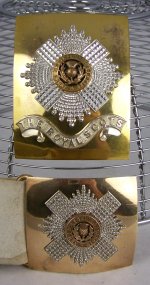
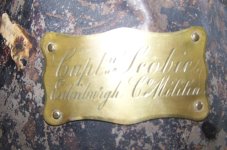
Shown below are Lt Col Scobie’s waist belt clasp and shoulder belt plate which are the same style as those for a regular officer. Also shown is the name plate on his helmet storage tin showing his rank as Capt (which he was in 1881) – I’m always very pleased to get a headdress still with its original storage tin, not only has this usually kept the item in very good condition, if it’s named it allows the original owner to be identified.
The Militia Act of 1852 and the outbreak of the Crimean War in 1854 gave renewed impetus to organising reformed Militia regiments. In September 1854 the establishment of the Edinburgh Militia was set at 26 officers, 40 non-commissioned officers, 6 drummers and 657 privates in six companies. It was commanded by the 5th Duke of Buccleuch, who was also the Lord-Lieutenant of Midlothian. The regiment was embodied for service on 12 February 1855 and the men were billeted throughout Dalkeith with the officers at the Cross Keys Hotel (I know this building well; it was built in 1804 as a coaching inn. It still exists today although it is no longer a hotel having been converted to residential apartments). The regiment lined the streets from the railway station to Holyrood Palace (the Royal residence in Edinburgh) on 6 September when Queen Victoria visited Edinburgh on her way to Balmoral Castle, and again on her return. As a result, the regiment was given the title 'Queen's Regiment of Edinburgh County Militia', quickly changed to 'The Edinburgh, or Queen's Regiment of Light Infantry Militia'. This rather cumbersome title was usually rendered as the Queen's Edinburgh Light Infantry (QELI). The Crimean War having ended early in 1856, the regiment was disembodied on 28 May. Militia units that had been embodied were not called up for annual training again until 1859, after which it was held every year, the year's recruits attending 14 or 21 days preliminary drill.
Under the 'Localisation of the Forces' scheme introduced by the Cardwell Reforms of 1872, militia regiments were formed into brigades with their local regular and volunteer battalions. For the QELI this was with the Royal Scots (Lothian Regiment) and their permanent staff were increasingly drawn from the Royal Scots. The militia was now under the control of the War Office rather than their county Lord Lieutenants and the officers' commissions were now signed by the Queen. Around a third of the recruits and many young officers went on to join the Regular Army. In 1878 the QELI's headquarters moved from Dalkeith to the brigade’s depot at the new Glencorse Barracks.
Pictured below is an officer’s shako from the QELI dating from the 1870’s. The shako plate shows a silver Star of the Order of the Thistle and the cross of St Andrew with a gilt thistle within a circlet pierced with the moto ‘Nemo Me Impune Lacessit’ (No-one provokes me with impunity) on a green enamel background. Above the plate is the blackened strung bugle to reflect the regiments status as Light Infantry.
The Childers Reforms of 1881 took the Cardwell reforms further, with militia regiments formally joining their linked regular regiments as numbered battalions. The QELI therefore became the 3rd (Edinburgh Light Infantry Militia) Battalion, Royal Scots in July 1881. On the outbreak of the Second Boer War in October 1899, most of the available regular army was sent to South Africa. Many militia units were embodied to replace them for home defence and to garrison certain overseas stations, while others volunteered for active service. The 3rd Royal Scots were embodied on 5 December 1899 and volunteered for service in South Africa. After an active campaign, they embarked for home on 7 May 1902 shortly before the end of the war and were disembodied on 28 May 1902, having lost 4 officers and 31 other ranks killed or having died of wounds or accidents. The participants received the Queen’s South Africa Medal with clasps for 'Transvaal', 'Orange River Colony' and 'Cape Colony, and the King’s South Africa Medal with the 'South Africa 1901' and 'South Africa 1902' clasps.
Pictured below is the helmet which belonged to Lt. Col. Mackay John Scobie (brief service details below the photos) who had been serving as a Captain in the QELI at the time of their becoming the 3rd (Edinburgh Light Infantry Militia) Battalion, Royal Scots. Accordingly, this helmet can be accurately dated to July 1881. The helmet fittings are in gilt matching those of a regular officer as was appropriate for this battalion (as opposed to silver for the Volunteers). This style of helmet plate was introduced to the Royal Scots in 1881 and is identical to that for the regular regiment (described in a previous post) except that the title scroll reads ‘The Lothian Regt’ which was worn by the Royal Scots from 1881 to 1891.
Lt Col Scobie initially joined the 42nd Regiment of Foot (The Black Watch) as an Ensign on 12 January 1867 and was promoted to Lieutenant in October 1871. The 42nd played a key role in the Third Anglo-Ashanti War (1873–1874). They were involved in major battles including the Battles of Amoaful and Ordashu, leading attacks and achieving decisive victories for the British under the command of Sir Garnet Wolseley. Four members of the regiment were subsequently awarded the Victoria Cross for their bravery during this conflict.
Lt Scobie retired from the 42nd on 23 July 1878 before being appointed as a Captain in the QELI on 31 January 1879. He was serving at the time of the transition to the 3rd (Edinburgh Light Infantry Militia) Battalion, Royal Scots and was promoted to Major on 26 June 1885. Sadly, he died suddenly on 27 September 1894 at which time he held the rank of honorary Lt Col and was noted as being second in command of the battalion.
Shown below are Lt Col Scobie’s waist belt clasp and shoulder belt plate which are the same style as those for a regular officer. Also shown is the name plate on his helmet storage tin showing his rank as Capt (which he was in 1881) – I’m always very pleased to get a headdress still with its original storage tin, not only has this usually kept the item in very good condition, if it’s named it allows the original owner to be identified.
Last edited:

