
RoyalScotsVols
Well-known member
Militia units had been raised in Scotland for centuries mostly for a home defence role as a reaction to short term emergencies. The Militia Act of 1852 was passed during a period of international tension to enable the raising of units within counties. These were to be filled on a voluntary basis although conscription by ballot could be used if counties failed to meet their quota. Training was for 56 days on enlistment then for 21 – 28 days per year during which time the men received full army pay.
The main distinction between the Militia and the Volunteers (progressively raised after 1859) was that the Militia served as reserves and could be called up at any time to supplement the Regular army. The Volunteers were intended to be used purely for local Home Defence.
The 1st Royal Lanark Militia originated as the Lanarkshire Militia in 1796, became the "Royal" Lanark Militia in 1802, and were designated "1st" in 1854. They were raised in the County of Lanark and headquartered in the town of Hamilton. Their officers were drawn from the local gentry with the rank and file recruited from the local population and time expired regulars. In 1881 under the Childers Reforms the unit assumed the title of 3rd and 4th (Militia) Battalions of the Highland Light Infantry.
The regiment was embodied to release regular units for the Crimean War and for active service during the Second Boer War. It is worth noting that Captain the Hon. Hore-Ruthven of the 3rd HLI was awarded the Victoria Cross for conspicuous gallantry in saving the life of a wounded Egyptian officer at Gedariff in September 1898. This was the first instance of a Militia officer being awarded this prestigious decoration.
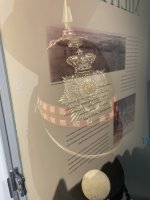
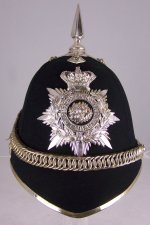
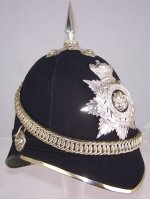
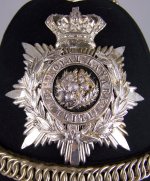
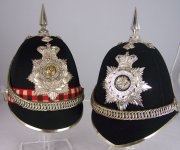
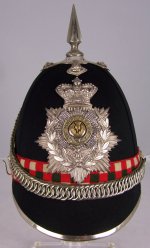
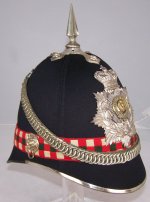
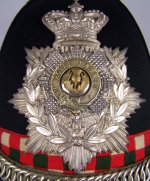
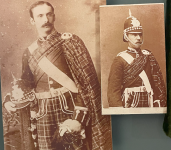
Pictured below is a helmet of the 1st Royal Lanark Militia which is named to Lieutenant Herbert Salwey who was commissioned on 17 February 1877 but resigned on 26 March 1879. This is clearly an early example of this helmet (introduced into the army in 1878) which Lt Salwey must have procured only a few months before leaving the unit as it has a rounded front peak and is before the final pattern of officers helmet plate was available. As shown, the helmet includes a chequered band which appears to have been unique to this regiment. Helmets of this style can only have been worn by the regiment until 1881 when the uniform of the HLI was adopted. Also shown are period photographs of this style of helmet in use by officers of the regiment.
The main distinction between the Militia and the Volunteers (progressively raised after 1859) was that the Militia served as reserves and could be called up at any time to supplement the Regular army. The Volunteers were intended to be used purely for local Home Defence.
The 1st Royal Lanark Militia originated as the Lanarkshire Militia in 1796, became the "Royal" Lanark Militia in 1802, and were designated "1st" in 1854. They were raised in the County of Lanark and headquartered in the town of Hamilton. Their officers were drawn from the local gentry with the rank and file recruited from the local population and time expired regulars. In 1881 under the Childers Reforms the unit assumed the title of 3rd and 4th (Militia) Battalions of the Highland Light Infantry.
The regiment was embodied to release regular units for the Crimean War and for active service during the Second Boer War. It is worth noting that Captain the Hon. Hore-Ruthven of the 3rd HLI was awarded the Victoria Cross for conspicuous gallantry in saving the life of a wounded Egyptian officer at Gedariff in September 1898. This was the first instance of a Militia officer being awarded this prestigious decoration.
Pictured below is a helmet of the 1st Royal Lanark Militia which is named to Lieutenant Herbert Salwey who was commissioned on 17 February 1877 but resigned on 26 March 1879. This is clearly an early example of this helmet (introduced into the army in 1878) which Lt Salwey must have procured only a few months before leaving the unit as it has a rounded front peak and is before the final pattern of officers helmet plate was available. As shown, the helmet includes a chequered band which appears to have been unique to this regiment. Helmets of this style can only have been worn by the regiment until 1881 when the uniform of the HLI was adopted. Also shown are period photographs of this style of helmet in use by officers of the regiment.
Last edited: