
RoyalScotsVols
Well-known member
The Childers Reforms introduced to the British Army in 1881 created larger regiments each comprising two regular battalions which would allow for one to serve at home whilst the other served abroad, often in India. At the same time, it was decided that a new elite regiment of Rifles should be established in Scotland. The 26th of Foot (The Cameronians) were chosen for this role as they had a strong reputation for marksmanship and they were the senior Scottish regiment that had only one battalion. The 90th Perthshire Volunteers who had a long tradition as Light Infantry were to be joined with them. Together they formed the 1st and 2nd Battalions of The Cameronians (Scottish Rifles). Those serving in the 26th became the 1st Battalion preferring to be known as The Cameronians whereas the 2nd Battalion comprised the 90th who referred to themselves as The Scottish Rifles. Both battalions adopted the rifle green uniforms with black buttons which were traditional for elite rifle regiments. The new regiment went on to serve in South Africa and in India as well as within the UK. In the First World War the regiment totalled 27 battalions with over 7,000 casualties who are commemorated on a magnificent memorial in Kelvingrove in Glasgow.
A total of ten battalions served during the Second World War. The 1st Battalion spent the entire time in the Far East and distinguished itself in the defence of India and as part of the famous Chindits who outwitted and eventually out-fought the Japanese in Burma. Meanwhile in 1939 the 2nd Battalion and two of the Territorial Battalions went to France with the British Expeditionary Force and, after heavy fighting in Belgium, were evacuated at Dunkirk. Later they along with a further Territorial Battalion went to the Middle East before joining the Eighth Army for the invasion of Sicily, the battle for Italy and the liberation of North West Europe.
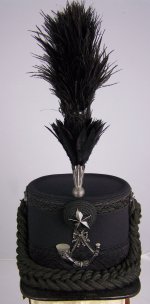
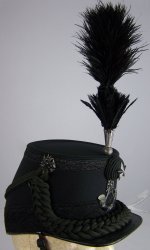
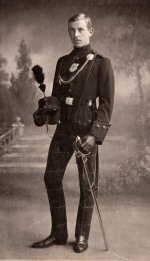
Shown below is an officer’s shako of The Cameronians (Scottish Rifles) worn from 1892 onwards. The shako has rifle green cloth covering with thistle pattern lace and an ostrich and vulture feather plume. The mullet on the cord boss is drawn from the older 26th regiment while the strung bugle reflects the Light Infantry tradition of the 90th. Also shown is an officer of the regiment with this pattern of shako.
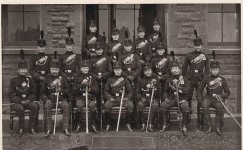
The photograph below is of the officers of the 1st Battalion which was taken at Maryhill Barracks in 1913. The officers are from left to right: Back row: 2nd Lt Hobkirk, Capt Rose, Lt Money, Lt Drew, Middle Row: 2nd Lt Arnott, 2nd Lt Becher, Lt Riddell-Webster, Capt Jack, Capt Lee, Capt Stormonth-Darling, Front Row: Capt Oakley, Lt-Quartermaster Brightman, Major Bliss, Lt Col Combe, Capt & Adjt MacAllan, Major Vandeleur, Capt Chaplin.
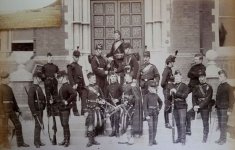
Below is a photograph taken in 1894 to show the various types of uniforms and orders of dress worn by the regiment at that time:
A total of ten battalions served during the Second World War. The 1st Battalion spent the entire time in the Far East and distinguished itself in the defence of India and as part of the famous Chindits who outwitted and eventually out-fought the Japanese in Burma. Meanwhile in 1939 the 2nd Battalion and two of the Territorial Battalions went to France with the British Expeditionary Force and, after heavy fighting in Belgium, were evacuated at Dunkirk. Later they along with a further Territorial Battalion went to the Middle East before joining the Eighth Army for the invasion of Sicily, the battle for Italy and the liberation of North West Europe.
Shown below is an officer’s shako of The Cameronians (Scottish Rifles) worn from 1892 onwards. The shako has rifle green cloth covering with thistle pattern lace and an ostrich and vulture feather plume. The mullet on the cord boss is drawn from the older 26th regiment while the strung bugle reflects the Light Infantry tradition of the 90th. Also shown is an officer of the regiment with this pattern of shako.
The photograph below is of the officers of the 1st Battalion which was taken at Maryhill Barracks in 1913. The officers are from left to right: Back row: 2nd Lt Hobkirk, Capt Rose, Lt Money, Lt Drew, Middle Row: 2nd Lt Arnott, 2nd Lt Becher, Lt Riddell-Webster, Capt Jack, Capt Lee, Capt Stormonth-Darling, Front Row: Capt Oakley, Lt-Quartermaster Brightman, Major Bliss, Lt Col Combe, Capt & Adjt MacAllan, Major Vandeleur, Capt Chaplin.
Below is a photograph taken in 1894 to show the various types of uniforms and orders of dress worn by the regiment at that time:
Last edited: