Unteroffizierschule Neubreisach in Elsaß

CLOVIS 57

Well-known member
Hello, this isn't a recent discovery, but it's a helmet I've discussed before on another French forum.

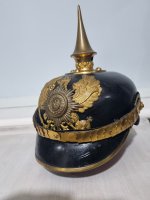
It's a helmet I bought when I was 15, in 1970. Back then, there was no one to guide us. I didn't know what it was. A spiked helmet with a Prussian eagle, a line infantry helmet, but with a "Stern Guard"... And marked U.S.N., like U.S. Navy!
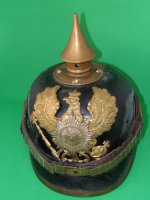
USN Uffz Preschool Neubreisach.JPG
I could have swapped the eagle for a standard line eagle. Fortunately, 10 years later, I learned of the existence of such a helmet in the T1 of the Larcade.
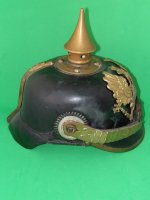
USN Uffz Preschool Neubreisach in Elasaß 2C.JPG
"Kammer" helmet, but with a superior quality liner in guilloché calfskin. The cockades are for Portepee.

It is actually an instructor's helmet from a school for non-commissioned officers.
Its unique feature is that it bears a Prussian line infantry eagle, but with a Stern Guard.
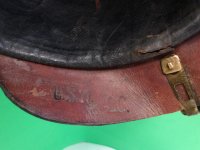
Uffzvorschule Neubreisach 2C.JPG
So by 1980, I already knew what the “U.S.” stood for: Unteroffizier-Schule. That left the “N.” It wasn't until about ten years ago that I found a link online explaining the “N.” It stands for Neubreisach in Alsace.

A very rare helmet that I couldn't identify when I bought it from a secondhand dealer in Colmar over 50 years ago.
 
Last edited:
Great helmet and a fantastic story! Just a small correction: Unteroffizier-Vorschule didn’t issue Pickelhauben, only Mützen. The “U.S.” on your helmet stands for Unteroffizierschule, not Vorschule. Different institutions. Still an exceptionally rare piece—thanks for sharing.

The German military school system at the time (excluding Kriegsakademie.) had various types, often overlapping, with both military and civilian elements interwoven. So it's easy to get confused.
 
Thank you for your comments.
Thank you Sudsend, I had noticed the existence of the School and the Preparatory School, but I didn't know the difference between them. Apparently, Neufbrisach was the only non-commissioned officer school in the Reichsland, that is, for AK 14, 15, and 16.
 
Nice and very uncommon helmet !!!!
the stamp "USN" would have been a mystery for me without the explanation.
thanks for sharing.
 
Hello all,
I totally agree that the Unteroffiziersvorschulen had complete other rules than the Unteroffiziersschulen.

The cadets at the non-commissioned officers’ preparatory school (Unteroffiziersvorschulen) were not military personnel. Unlike the non-commissioned officers’ school (Unteroffiziersschulen), where military training was the primary focus, the preparatory school was intended to lay the general intellectual and moral foundations, as well as the physical fitness, required for a future career in the military.
This was supplemented by a certain amount of military training. According to the basic regulations of 31 March 1888, the curriculum covered German, arithmetic, history, geography, natural history, calligraphy, drawing, map-drawing and singing. To be admitted, the trainee required the consent of their legal guardian. For every full or partial month spent at the preparatory school, the pupil was required to remain on active duty in the army for two months, up to a maximum of four years in total, beyond the statutory period of service. He was provided with everything necessary for his subsistence free of charge. The pocket money of 75 pfennigs a month (!) was intended for cleaning supplies and small purchases.

Further and for those reasons, Thierry, I do not think that the US on your helmet could be the abreviation for Unteroffiziersvorschule, but for Unteroffiziersschule.

We need first to recapitulate as follow:

- Juli 1824: creation of the first Unteroffiziersschule in Potsdam
- 1860: creation of the second US: Jülich
- 1867: creation of the third US: Biebrich (moved April 1914 to Wetzlar)
- 20.4.1868: Creation of the fourth US: Struppen in Sachsen (moved 1873 to Marienberg in Sachsen)
- 1869: creation of the fifth US: Weißenfels
- 1870: creation of the sixth US: Ettlingen (near Karlsruhe)
- 1879: creation of the seventh US: Marienwerder
- 1901: creation of the eighth and last US: Treptow an der Rega (Westpommern)

And......Juli 1916, the US Marienberg moved to Frankenberg and the US Jülich to......Northeim... ;)

And about the Unteroffiziersvorschulen, that were not military:

- 1877: creation of the UVS Weilburg
- 1878: creation of the UVS Marienberg
- 1880: creation of the UVS Annaburg
- 1888: creation of the UVS Neubreisach (moved 1910 to Sigmaringen)
- 1891: creation of the UVS Jülich (moved 1916 to Biebrich)
- 1891: creation of the UVS Marienberg in Sachsen
- 1893: creation of the UVS Wohlau (Schlesien)
- 1894: creation of the UVS Fürstenfeldbruck (Bavaria)
- 1896: creation of the UVS Bartenstein
- 1897: creation of the UVS Greifenberg (Pommern)
- 1915: creation of the UVS Jena (moved 1917 to Frankenstein and Mölln)
- 1916: creation of the UVS Ellwangen

Philippe
 
Thank you, Soudain and Philippe, for your very informative answers. I noted that the schools were assigned to two companies, which is consistent with the 2C marking.
But I have two questions:
---I understand that the students in “military preparatory school” (Vorschule) wore caps. However, what about the “military instructors”?
---And if they were allowed to wear spiked helmets, what would the markings have been?

Northeim is far from Colmar, whereas Neufbrisach is right next door. This helmet isn't vintage, but it's an M95, which is a bit anachronistic for 1916... although since this was a school, I don't think they were subject to the M15 and later Stahlhelm requirements.
 
This helmet isn't vintage, but it's an M95, which is a bit anachronistic for 1916... although since this was a school, I don't think they were subject to the M15 and later Stahlhelm requirements.
Instructors in military schools and even in Ersatz Bataillonen or Ersatz-Batterien in the Heimat could have worn such pre war helmet mit chinscales up to 1916 or even later...
Unteroffiziersschulen also had a few companies... US never could have been the german abreviation for Unteroffiziersvorschule, just my two cents...
Thierry, I think you know, that our collection items already have travelled a lot before one could have purchase them....Second hand dealers also have their supply chains, even 1970 or 1980....The first dealers were the US soldiers who brought back home a big amount of helmets.
Philippe
 
Last edited:
Thanks, Philippe.;)
So U.S.N. stands for Northheim.

Since this school dates from July 1916, that would mean a new M95 helmet (high-quality), specially manufactured for a military instructor or administrative officer, because at that time this helmet—especially with its scale-patterned chin strap—was “not suitable for field use.”
 
However, what about the “military instructors”?
---And if they were allowed to wear spiked helmets, what would the markings have been?
In the German Vorschule, military instructors are typically officers temporarily seconded from various units of the German Army. They usually wear the uniform of their original unit, meaning their headgear often indicates which branch or regiment they come from. For instance, if a military instructor is from an infantry regiment, he would typically wear a Pickelhaube.
 
In the German Vorschule, military instructors are typically officers temporarily seconded from various units of the German Army. They usually wear the uniform of their original unit, meaning their headgear often indicates which branch or regiment they come from. For instance, if a military instructor is from an infantry regiment, he would typically wear a Pickelhaube.
Thank you, Soudain, for your reply. Actually, I just wanted to know if a “military instructor” at a Vorschule could wear a spiked helmet.
 
Back
Top