


Khukri
Well-known member
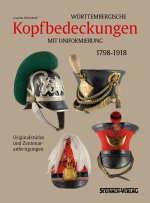
Looking forward to receive this one: from Berliner Zinnfiguren.
ISBN 978-3-929652-07-9
Best No. 9613 | EUR 58.00
by Joachim Hilsenbeck
Württemberg headgear
with uniforms, 1798-1918
With this new book, which describes the topic of Württemberg's headgear with uniformization period from 1798 to 1918, I want to present you not only original pieces, but mainly centenary productions.
Zentenar (hundred-year-old) means 100th anniversary celebrations by certain regiments who carried out their anniversary in the form of equestrian festivals, 100th anniversary or even chief jubilee and so-called regimental chapels at the turn of the century.
These celebrations have included uniforms worn during battles and campaigns over the past 100 years. Headgear is made from simple materials and partly using parts of original pieces. Only the blank weapons were taken over from a later time. The events were followed by plays by warriors from ancient times, as well as sieges of a fortress or a company returning from Russia. Ultimately, these celebrations ended with the homage of His Majesty King William II of Württemberg.
A special representation for the equestrian festival of the Dragoon Regiment No. 26 King was taken over by Duke Robert of Württemberg. He played the role of the herald and appeared in various uniforms.
Unfortunately, centenary pieces are not properly accepted by collectors today and are classified as copies. This is also true in a certain sense: but why are there centenary productions? The reason is quite simple: these pieces, some of which date back to the Napoleonic era, can only be found in the original as fragments in the museum's collection.
However, a centenary piece is still 100 years old, i.e. treated equivalent to helmets or uniforms from the imperial era, but not an original piece from the period around 1903, 1905, 1912, etc., when the 100th anniversary celebrations took place.
One should therefore think differently about these productions, because they are, after all, a piece of contemporary history, which unfortunately can no longer be represented in the original.
After the coronation of Elector Frederick as King Frederick by Napoleon I, Württemberg became a kingdom on 1 January 1806. But the sovereignty so emphasized remained narrowly limited to the outside world. The king had to do what Napoleon wanted. A major political change in Germany was brought about by the League of the Rhine, founded by Napoleon I. The King of Württemberg had to provide 12,000 men and in 1809 the troops left their garrisons.
The Württemberg troops moved to West Prussia in March 1812 to march from there to Russia on 25 June 1812. In this campaign, more than 10,000 Württemberg residents were killed.
This is a major reason why there are not many original pieces left from the Napoleonic era. Later uniforms and headgear under King William I and King Charles were modified and removed, reused, and even the people of Württemberg were a frugal people!
In the introduction you will find a brief outline of the Württemberg military and its rulers from 1638 to 1871.
The Württemberg uniformization during the reign of King Frederick of 1797-1816 includes the 1st part. This text is framed with original lithographs, drawings, paintings as well as real estate pieces and photos of centenary celebrations, uniform pieces and headgear.
A brief description of the uniformity of the Württ. Troops provide a brief insight into how the uniformity has changed from Regent to Regent.
The Württemberg uniformity during the reign of King William I of 1816-1864, as well as the development of performance, provides an overview of this era.
In between, read a short biography of His Highness Duke William I of Urach. Personal uniform, chainsaws and various paintings.
The Württemberg uniformization during the reign of King Charles of 1864-1891 continues. A completely new uniform with headgear was introduced according to the Austrian model. A short dark blue, double-breasted weapon skirt, dark grey trousers with red advances. The headgear was a dark blue service cap. Some original pieces are still preserved from this era, but there are still centenary productions.
The Württemberg uniformization during the reign of King Wilhelm II from 1891 to 1918 concludes with original photographs from his service and centenary celebrations. With the change of uniform again in single-row coat of arms and, following the Prussian model, with the pimple hood, the colourful skirt also ended in 1914. From here we went over to the field gray uniform with the steel helmet.
At the end, you'll see a battle calendar of the Württ. Troops of 1793-1871, a deployment and development of the troops and units of XIII. Army Corps and locations.
 steinach-verlag.de
ISBN 978-3-929652-07-9
Best No. 9613 | EUR 58.00
by Joachim Hilsenbeck
Württemberg headgear
with uniforms, 1798-1918
With this new book, which describes the topic of Württemberg's headgear with uniformization period from 1798 to 1918, I want to present you not only original pieces, but mainly centenary productions.
Zentenar (hundred-year-old) means 100th anniversary celebrations by certain regiments who carried out their anniversary in the form of equestrian festivals, 100th anniversary or even chief jubilee and so-called regimental chapels at the turn of the century.
These celebrations have included uniforms worn during battles and campaigns over the past 100 years. Headgear is made from simple materials and partly using parts of original pieces. Only the blank weapons were taken over from a later time. The events were followed by plays by warriors from ancient times, as well as sieges of a fortress or a company returning from Russia. Ultimately, these celebrations ended with the homage of His Majesty King William II of Württemberg.
A special representation for the equestrian festival of the Dragoon Regiment No. 26 King was taken over by Duke Robert of Württemberg. He played the role of the herald and appeared in various uniforms.
Unfortunately, centenary pieces are not properly accepted by collectors today and are classified as copies. This is also true in a certain sense: but why are there centenary productions? The reason is quite simple: these pieces, some of which date back to the Napoleonic era, can only be found in the original as fragments in the museum's collection.
However, a centenary piece is still 100 years old, i.e. treated equivalent to helmets or uniforms from the imperial era, but not an original piece from the period around 1903, 1905, 1912, etc., when the 100th anniversary celebrations took place.
One should therefore think differently about these productions, because they are, after all, a piece of contemporary history, which unfortunately can no longer be represented in the original.
After the coronation of Elector Frederick as King Frederick by Napoleon I, Württemberg became a kingdom on 1 January 1806. But the sovereignty so emphasized remained narrowly limited to the outside world. The king had to do what Napoleon wanted. A major political change in Germany was brought about by the League of the Rhine, founded by Napoleon I. The King of Württemberg had to provide 12,000 men and in 1809 the troops left their garrisons.
The Württemberg troops moved to West Prussia in March 1812 to march from there to Russia on 25 June 1812. In this campaign, more than 10,000 Württemberg residents were killed.
This is a major reason why there are not many original pieces left from the Napoleonic era. Later uniforms and headgear under King William I and King Charles were modified and removed, reused, and even the people of Württemberg were a frugal people!
In the introduction you will find a brief outline of the Württemberg military and its rulers from 1638 to 1871.
The Württemberg uniformization during the reign of King Frederick of 1797-1816 includes the 1st part. This text is framed with original lithographs, drawings, paintings as well as real estate pieces and photos of centenary celebrations, uniform pieces and headgear.
A brief description of the uniformity of the Württ. Troops provide a brief insight into how the uniformity has changed from Regent to Regent.
The Württemberg uniformity during the reign of King William I of 1816-1864, as well as the development of performance, provides an overview of this era.
In between, read a short biography of His Highness Duke William I of Urach. Personal uniform, chainsaws and various paintings.
The Württemberg uniformization during the reign of King Charles of 1864-1891 continues. A completely new uniform with headgear was introduced according to the Austrian model. A short dark blue, double-breasted weapon skirt, dark grey trousers with red advances. The headgear was a dark blue service cap. Some original pieces are still preserved from this era, but there are still centenary productions.
The Württemberg uniformization during the reign of King Wilhelm II from 1891 to 1918 concludes with original photographs from his service and centenary celebrations. With the change of uniform again in single-row coat of arms and, following the Prussian model, with the pimple hood, the colourful skirt also ended in 1914. From here we went over to the field gray uniform with the steel helmet.
At the end, you'll see a battle calendar of the Württ. Troops of 1793-1871, a deployment and development of the troops and units of XIII. Army Corps and locations.
aus dem Inhalt Württ. Kopfbedeckungen – Steinach-Verlag
steinach-verlag.de
Attachments
Last edited: