Highland Light Infantry - 'Hells Last Issue'

RoyalScotsVols

Well-known member
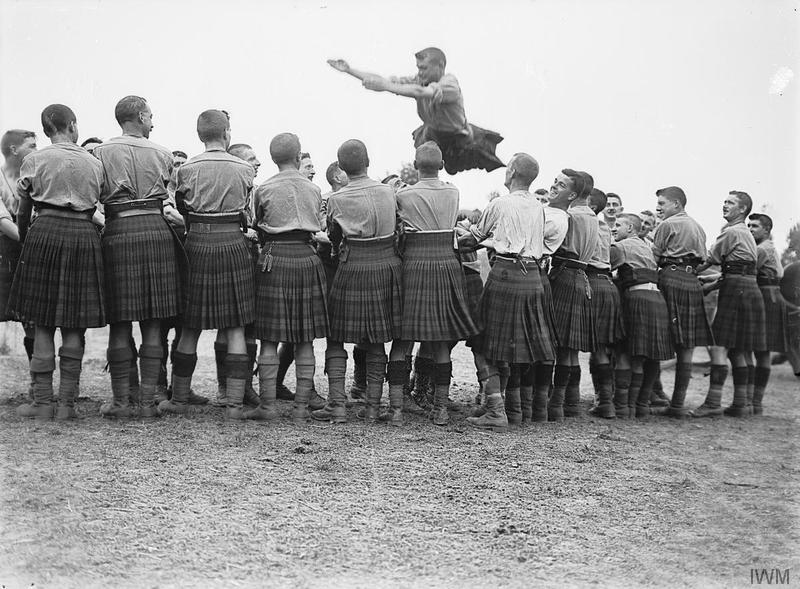
The Highland Light Infantry (nicknamed ‘Hells Last Issue’) were a light infantry regiment of the British Army formed in 1881 by the amalgamation of the 71st (Highland) Light Infantry (as the 1st Battalion) and the 74th (Highland) Regiment of Foot (as the 2nd Battalion). The 71st had been established in 1777 with strong Jacobite roots with the 74th being initially established in 1787. The HLI’s definition as either a Highland or Lowland regiment was ambiguous as although it recruited mainly from the Glasgow area in Lowland Scotland it insisted on being classified as a non-kilted Highland regiment. On formation the regiment wore tartan trews in place of the kilt as was common for Lowland regiments. Although trews had originally been just as much the mark of a Highlander as the kilt, the adoption of trews by Lowland regiments in 1881 was considered by many to have devalued them as Highland garb. For many years the HLI laid claim to the kilt and tried to have it restored to the regiment before being finally successful in 1947.

The war records for both the 1st and 2nd Battalions were equally outstanding having been involved in the Anglo-Egyption War, the Second Boer War and extensively during the First and Second World Wars. The regiment gained 48 Battle Honours and had been awarded a total of 14 Victoria Crosses for gallantry. The HLI were amalgamated with the Royal Scots Fusiliers in 1959 to form The Royal Highland Fusiliers.

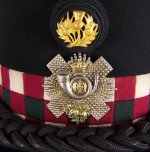
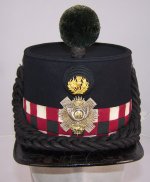
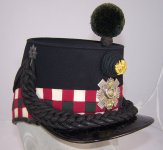
Pictured below is an officer’s shako from the late Victorian period with the badge showing the Star of the Order of the Thistle and St Andrews Cross with the light infantry bugle and the monogram ‘HLI’ in the centre twist. A Guelphic crown is superimposed over the upper point of the Star and over the lower point is a scroll carrying ‘Assaye’ above an elephant. The Thistle Star and bugle horn are derived from the 71st and the scroll and elephant are drawn from the battle honour awarded to the 74th for their fine showing at that battle in September 1803.

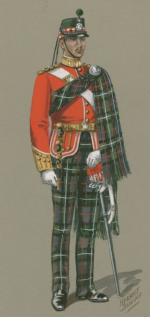
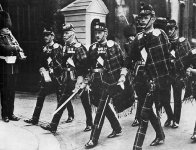
Also shown is an illustration of an officer’s full uniform along with a photograph of the famous actor David Niven (on the extreme right) who, when he was undergoing his officer training, was asked to list in order of preference the three regiments to which he would elect to be commissioned. Apparently, he wrote ‘Anywhere but the HLI’ so, naturally, the army commissioned him there!
000_1119.JPG000_1121.JPG000_1120.JPGScreenshot 2025-08-31 201021.pngpost-873-047363500 1291178595.jpg
 
Thank you for this excellent post. My Scottish grandfather fought with the HLI from 1914 to 1918. He enlisted in Glasgow prior to the beginning of the war. I have tried to find his service records but have been told that these were destroyed during the London blitz. I do know that he served at the Dardanelles, in Egypt and finally France. Very cool to see a young David Niven in parade uniform. Your Shako is in beautiful condition!
 
Last edited:
Thank you for this excellent post. My Scottish grandfather fought with the HLI from 1914 to 1918. He enlisted in Glasgow prior to the beginning of the war. I have tried to find his service records but have been told that these were destroyed during the London blitz. I do know that he served at the Dardanelles, in Egypt and finally France. Very cool to see a young David Niven in parade uniform. Your Shako is in beautiful condition!

Hi Brian,

Many thanks for your note! It’s interesting to hear that your grandfather was in the HLI during the First World War. Sadly, as you say, a great many of the individual records were lost when the London storehouse was bombed in the Blitz. As you know, all regiments were expanded dramatically during the war with the HLI being increased to a total of 26 Battalions. From the places your grandfather served I think he was with one of the following three Battalions in the Territorial Force probably having joined in the run-up to the war as many young men did:
  • 1/5th (City of Glasgow) Battalion; or
  • 1/6th (City of Glasgow) Battalion; or
  • 1/7th (Blythswood) Battalion
These three battalions served closely together in the same theatres and formed the 157th (Highland Light Infantry) Brigade, part of the 52nd Lowland Division. If this was where your grandfather served, he will likely have seen significant action as their war record was:
  • August 1914: Mobilised from their respective bases at Garnethill, Yorkshill Street or Bridgeton in Glasgow to form part of the HLI Brigade in the Lowland Division initially moving to Dunfermline for build-up training.
  • 11 May 1915: The formation became the 157th (HLI) Brigade assigned to the 52nd (Lowland) Division.
  • 26 May 1915: Sailed from Devonport for Gallipoli, going via Egypt (5-28 June) and Mudros Harbour on the Greek island of Lemnas (1 July), landing at Cape Helles on 3 July. They were in action at Gulley Ravine (where their sister Brigade, the 156th (Scottish Rifles) suffered heavy casualties) and the attack towards Krithia along Achi Baba Nullah which captured the Ottoman trenches but resulted in heavy casualties.
  • 8 January 1916: Evacuated from Gallipoli to Mudros they arrived in Egypt on 3 February and were in action the Battle of Romani in August. Following the battle, they advanced across the Sinai occupying Bir el Abd, El Mazar and El Arish, but remained in a supporting role. In 1917 they were in action during The First, Second and Third Battles of Gaza, The Battle of Jerusalem and the Battle of Jaffa which included the crossing of the Nahr-el-Auja river.
  • 11 April 1918: The Division left Egypt and arrived in Marseilles on 17 April for service on Western Front presumably in response to the German Spring Offensive. They fought in the Second Battle of the Somme, the Second Battle of Arras, and the Battle of the Hindenburg Line during the Hundred Days Offensive. At the Armistice, the 52nd Division was north of the Mons canal engaged on clearing Herchies.
If you are ever able to visit Glasgow, the RHF Museum on Sauchiehall Street is well worth visiting as they hold many artifacts and records for the HLI.
 
Last edited:
As mentioned earlier, I have a fondness for the Lowland regiments as my forebears hailed from Roxburoughshire on The Borders.

The shako is a lovely piece in fine condition.

Speaking of David Niven, his autobiography "The Moon's a Balloon" is hilarious, as are some of his remembrances of his time with the HLI. Well worth the read.
 
RSV: Thank you very much for this RHLI summary. We are visiting friends right now but I will look up the information I do have on my grandfather’s service and see if I can relate it to what you have posted. 😊👍
 
Great shako and fascinating history!
I note you say the 71st established in 1777 had strong Jacobite roots. As the Jacobite cause was defeated at Culloden in 1746, how did this come about?
 
RSV: Thank you very much for this RHLI summary. We are visiting friends right now but I will look up the information I do have on my grandfather’s service and see if I can relate it to what you have posted. 😊👍
I attach a link below to an internet page which gives a breakdown of the movements of the various HLI battalions which may assist you to narrow down your grandfather’s unit. Only the 5th, 6th and 7th battalions were part of the 157th (HLI) Brigade which appear to have served in Gallipoli, Egypt and France.


Should you feel that your grandfather could have been in one of these three battalions, there is a link on this page (under the ‘Books’ heading) to a free pdf download of ‘The Fifth Battalion Highland Light Infantry in the war, 1914 -1918’. This history was written shortly after the war by the officers of the battalion – a number of units prepared these histories and, where they are available, they are an absolute gold-mine of information. Even if your grandfather was in the 6th or 7th battalions his experiences would have been similar to the 5th.

At the bottom of the page there is a further link where you will find the list of units within the 52nd (Lowland) Division and a summary of their war record.
 
Great shako and fascinating history!
I note you say the 71st established in 1777 had strong Jacobite roots. As the Jacobite cause was defeated at Culloden in 1746, how did this come about?
The Jacobite roots of the 71st (Highland) Light Infantry were in the regiment raised in 1777 by John Mackenzie, the eldest son of the Earl of Cromartie (the modern spelling now being ‘Cromarty’). He had the title of ‘Lord MacLeod’ and fought with his father’s clan for the Jacobites in the Battle of Falkirk Muir, leading 500 Clansmen in the 1745 Uprising. He was captured the day before the Battle of Culloden and imprisoned although he was later pardoned because of his youth and on condition of relinquishing his Earldom to the Crown. On his release, he travelled to Sweden where he joined the Swedish army as a mercenary and became an extremely distinguished soldier rising to the rank of Lieutenant-General and being subsequently decorated with the award of Commander, Order of the Sword of Sweden. During the Seven Years War he joined the Prussian Army as a volunteer, serving through the second campaign of 1757. Having been created a Count of Sweden, he returned to Scotland in 1771.

At the outbreak of the American War of Independence, he offered his services to King George III raising the 73rd Regiment (known as ‘MacLeod’s Highlanders) in 1777 but being renumbered as the 71st in 1786. He was now officially styled as ‘John Mackenzie known as Lord MacLeod’ because, although he had been stripped of the title following his involvement with the Jacobites, he was still known as a ‘Lord’ to his Clansmen. Most of the men that initially enlisted belonged to his Clan from his old estates on the Moray Firth and Cromarty Firth with the remainder being recruited in Glasgow. This began the regiment’s long association with this city to which many Highland men migrated over the centuries.
 
Last edited:
Back
Top