
RoyalScotsVols
Well-known member
The Highland Light Infantry (nicknamed ‘Hells Last Issue’) were a light infantry regiment of the British Army formed in 1881 by the amalgamation of the 71st (Highland) Light Infantry (as the 1st Battalion) and the 74th (Highland) Regiment of Foot (as the 2nd Battalion). The 71st had been established in 1777 with strong Jacobite roots with the 74th being initially established in 1787. The HLI’s definition as either a Highland or Lowland regiment was ambiguous as although it recruited mainly from the Glasgow area in Lowland Scotland it insisted on being classified as a non-kilted Highland regiment. On formation the regiment wore tartan trews in place of the kilt as was common for Lowland regiments. Although trews had originally been just as much the mark of a Highlander as the kilt, the adoption of trews by Lowland regiments in 1881 was considered by many to have devalued them as Highland garb. For many years the HLI laid claim to the kilt and tried to have it restored to the regiment before being finally successful in 1947.
The war records for both the 1st and 2nd Battalions were equally outstanding having been involved in the Anglo-Egyption War, the Second Boer War and extensively during the First and Second World Wars. The regiment gained 48 Battle Honours and had been awarded a total of 14 Victoria Crosses for gallantry. The HLI were amalgamated with the Royal Scots Fusiliers in 1959 to form The Royal Highland Fusiliers.
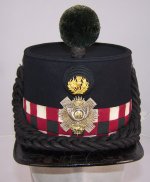
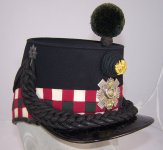
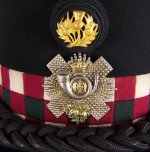
Pictured below is an officer’s shako from the late Victorian period with the badge showing the Star of the Order of the Thistle and St Andrews Cross with the light infantry bugle and the monogram ‘HLI’ in the centre twist. A Guelphic crown is superimposed over the upper point of the Star and over the lower point is a scroll carrying ‘Assaye’ above an elephant. The Thistle Star and bugle horn are derived from the 71st and the scroll and elephant are drawn from the battle honour awarded to the 74th for their fine showing at that battle in September 1803.
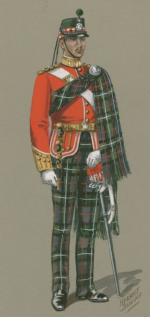
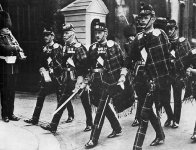
Also shown is an illustration of an officer’s full uniform along with a photograph of the famous actor David Niven (on the extreme right) who, when he was undergoing his officer training, was asked to list in order of preference the three regiments to which he would elect to be commissioned. Apparently, he wrote ‘Anywhere but the HLI’ so, naturally, the army commissioned him there!
The war records for both the 1st and 2nd Battalions were equally outstanding having been involved in the Anglo-Egyption War, the Second Boer War and extensively during the First and Second World Wars. The regiment gained 48 Battle Honours and had been awarded a total of 14 Victoria Crosses for gallantry. The HLI were amalgamated with the Royal Scots Fusiliers in 1959 to form The Royal Highland Fusiliers.
Pictured below is an officer’s shako from the late Victorian period with the badge showing the Star of the Order of the Thistle and St Andrews Cross with the light infantry bugle and the monogram ‘HLI’ in the centre twist. A Guelphic crown is superimposed over the upper point of the Star and over the lower point is a scroll carrying ‘Assaye’ above an elephant. The Thistle Star and bugle horn are derived from the 71st and the scroll and elephant are drawn from the battle honour awarded to the 74th for their fine showing at that battle in September 1803.
Also shown is an illustration of an officer’s full uniform along with a photograph of the famous actor David Niven (on the extreme right) who, when he was undergoing his officer training, was asked to list in order of preference the three regiments to which he would elect to be commissioned. Apparently, he wrote ‘Anywhere but the HLI’ so, naturally, the army commissioned him there!