Guard Kurassier Regiment kurass

cptbob

Well-known member
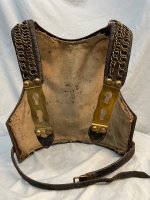
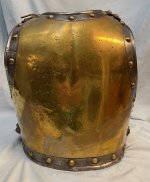
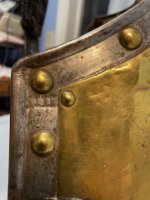
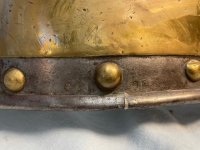
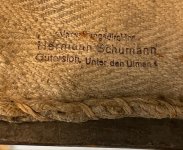
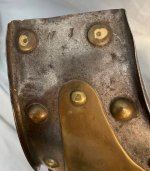
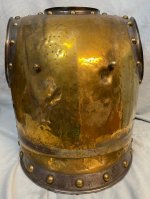
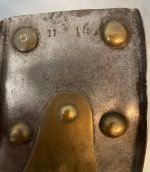
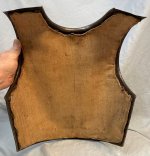
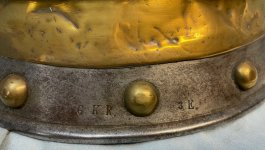
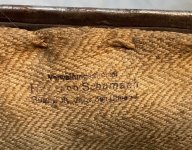
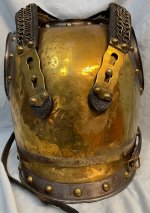
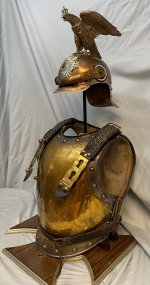
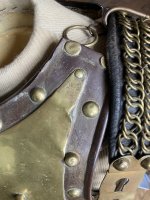
Because of the lack of stichblatt, I think the back plate may be a captured French piece. It is a bit smaller than the front plate so not a matched set. On the left side there are some markings. What looks like 4 capital I’s and what looks like AP. Unit marked GKR 3 E on the skirt. Both front and back plate have a small ink stamp on the lining. I can’t quite make out the first line ( ends with direktor).
IMG_6459.jpeg
IMG_6460.jpegIMG_6468.jpegIMG_6467.jpegIMG_6466.jpeg
 
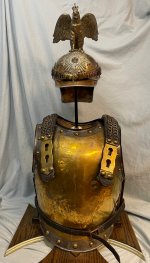
The front plate I believe is a Prussian model 1845. It is marked on one shoulder WJ ( Wilhelm Jaeger?) and on the other is an acceptance stamp along with 2 capital I’s and a 14. The front has the dent where it was tested. It is also marked GKR 3E on the skirt. IMG_6475.jpegIMG_6472.jpeg

IMG_6476.jpegIMG_6479.jpegIMG_6478.jpegIMG_6481.jpeg
 
Last edited:
The front plate I believe is a Prussian model 1845. It is marked on one shoulder WJ ( Wilhelm Jaeger?) and on the other is an acceptance stamp along with 2 capital I’s and a 14. The front has the dent where it was tested. It is also marked GKR 3E on the skirt.
Yes, Wilhelm Jaeger. The "II" is the size.
FW stands for King Friedrich-Wilhelm IV.
 
Because of the lack of stichblatt, I think the back plate may be a captured French piece. It is a bit smaller than the front plate so not a matched set. On the left side there are some markings. What looks like 4 capital I’s and what looks like AP. Unit marked GKR 3 E on the skirt.
Congratulations. Your back plate is a Napoleonic 1812 French Caribinier Heavy Cavalry Cuirass with brass plate. Captured in 1814 at Versailles or at Waterloo in 1815 by the Preussens, then finally issued to the newly raised Garde Kürassier Regt. in 1822.

Both front and back plates are typically stamped “AP”. Some believe it is “Aliene de Paris” or “Alphonse de Paris” or “Ateliers de Paris”, all incorrect.

The AP stamp stands for “Atelier de Precision”, an institute under the supervision and run by the Artillery Committee, which in turn operated under the supervision of the Department of War. Essentially it was an arsenal distribution facility.
 
I wish I could say I was that smart, but it was Francis and Sandy who helped me with research. One last thing, your set is not a mismatch. Cuirass would be fitted to each Kürassier at a Kammer (QM) so it’s common to find an 1812 French captured breast armour, matched up with a German made replacement or M1845 breast armour. This is a wonderful way to end 2025 for you Bob!
 
Yes, as Tony wrote, the "Atelier de Precision (AP) de l'Arsenal de Paris" was a workshop where delicate military instruments for artillery and else were developed and engineered, as well as small arms and other equipment. New cuirasses were proofed there. They also collected swords, helmets, cuirasses... on battlefields that were cleaned, restored, and re-assigned. Today, there is only one building left from the Paris Arsenal: la Bibliotheque de l'Arsenal, close to Bastille, which is open to the public and rich of about a million books and innumerable other documents.
When I saw the back of the cuirasse presented by Bob, I immediately thought of a French carabinier cuirasse (I have a complete one) but I have two questions:
- You say it should be a Napoleonic example collected after Waterloo, which is very possible. Is it dated? If not, it could also date back to the Franco-Prussian war in which both carabinier regiments were engaged before being disbanded in 1871
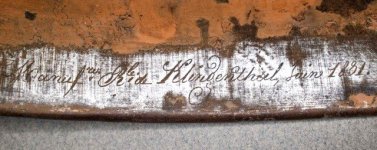
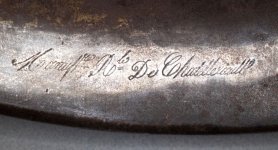
- Being originally French, the back should be maker-marked, usually Manufacture Royale de Chatellerault, or Manufacture Royale de Klingenthal. This should appear under the skirt on the lower part of the back. However, it is written in fine characters and can easily be missed, especially if the metal is oxidized. I was wondering whether you could identify such markings, which also often mention the year of production. The markings may have been hammered by the Prussians though...

This is a great item; congratulations!
s684491630860034848_p764_i5_w640.jpegs684491630860034848_p764_i1_w640.jpeg
 
One last thing, your set is not a mismatch. Cuirass would be fitted to each Kürassier at a Kammer (QM) so it’s common to find an 1812 French captured breast armour, matched up with a German made replacement or M1845 breast armour.
No, those two halves were never a pair. The scale chains of the 1814 cuirasses are much shorter than those of the 1845 model. It doesn't fit. You can see that here, too.
Prussia captured enough cuirasses in France in 1814 to supply all its regiments. By 1815, when the Battle of Waterloo took place—we Prussians call it the Battle of Belle Alliance—there were already enough.
 
- Being originally French, the back should be maker-marked, usually Manufacture Royale de Chatellerault, or Manufacture Royale de Klingenthal. This should appear under the skirt on the lower part of the back. However, it is written in fine characters and can easily be missed, especially if the metal is oxidized. I was wondering whether you could identify such markings, which also often mention the year of production. The markings may have been hammered by the Prussians though...
Chatellerault and Klingenthal did not produce cuirasses for the 1st French Empire. Chatellerault only produced the later model with fewer rivets around the edge.
 
Bob look for a stamp A.WOLLERS. This was a stamp used by a known French maker of French Cuirass.

Olaf, the Cuirass shoulder straps are held onto the back armour with a removable bolt. Front with back weigh an impressive almost 8600 gram, with most of it on the chest. The straps were easily replaceable as they must have broken very often. A GKR marked Cuirass is not one used at Waterloo as the GKR did not receive the Cuirass until 1822.
8DFF746F-C315-42D3-AF83-0703CB23BA39.jpeg
 
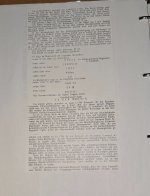
By Georg PETSCHKE
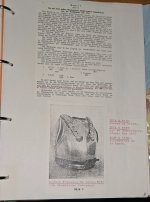
From the J-L. LARCADE Archive Kürassiere binder. Kürasse.

Translation:

-Second Muster/Pattern: -Spoils of war 1814: double cuirass covered with “yellow” brass plates.

The cuiras is composed of soft iron: as a special decoration, a brass plate has been soldered on the chest and back and additionally attached to the corners with brass staples. These brass plates leave the edges of the iron cuirass free over a width of about 3 cm, in this way the cuirass looks like a brass cuirass with iron edges. Because of this brass layer, the cuirass is noticeably heavier than the previous model in bare iron. With lining and cuffs: 8500 g. As with the first model, the edges of the cuirass are edged by a rolled-up collar of 9 mm wide and 3 mm high. Only the neck now has the edge of about 5 mm bent outwards and thus forms a real Stichblatt; In other words: an edge to ward off blades. In the iron edge of the cuirass are the staples for attaching the textile lining. As mentioned, the number of staples - both in the chest and back - is 34 pieces each; The diameter of the heads of these staples can vary between 14 and 17 mm. The chest part shows a clear keel. The part of the chest part is about 5 cm wide in the middle and reduces to about 4 cm on the sides. The two buttons for hooking in brass closure plates of the shoulder straps are located at the level of the nipples. The dorsal part shows between the shoulder blades and weak and flat perpendicular groove. As with the first model, the above-mentioned edge staples are used to attach the 2 cm wide band that runs completely around the inner edge of the cuirass. The staples have a screw thread and are fastened on the inside with a rondelle and square brass nut. The linen inner lining is sewn to the waistband. The cuffs are of the same shape as described in model 1.

-Between 1881 and 1885 the name Cürassier will be changed to Kürassier. This is evident from the stamping of the lining.

-Deviating from the normal way of attaching the shoulder straps to the back piece by means of hinge plates, the shoulder straps are attached directly to the back piece in a very simple way by two staples. These black leather shoulder straps; width is approximately 3.3 cm. On the side and at the top they have an almost 8 mm thick leather border. These leather straps are protected by two brass chains placed next to each other. These chains run from the two staples at the level of the shoulders - with which they are attached to the back piece - to the bottom; to the two staples with which the brass end pieces are attached to the leather shoulder straps. The full length of the shoulder straps is 73 cm. The waist belt is 2 cm wide - the buckle is on the left part and the attachment of both waist belt parts with two screw staples each.

-The greatest height of the cuirass is 42 cm, the greatest width from the outside is 88 cm. Neckline 19 X 19 cm, the arm openings are 19.3 x 22 cm in size. On the inside: 87 cm circumference.

- Without a doubt, one of these 600 to 700 cuirasses that the Brandenburg cuirassiers regiment took from a Paris warehouse on April 4, 1814. Officers were also equipped with this. In the year 1821 the cuirassiers of this regiment were obliged to hand over their yellow cuirasses to the newly formed Garde Cuirassier regiment.

- Here it is appropriate to take a brief overview of the types of shoulder straps: presumably the cuirasses captured in Paris and Versailles in 1814 had brass chains as protection for the shoulder straps; As for the yellow cuirasses. And the shoulder straps with brass scales for the cuirasses made of bare iron. The cuirasses of the GdC and the Brandenburg cuirassier regiment were yellow and the shoulder straps with brass chains. Also in 1821 when the Brandenburg cuirassiers regiment handed over its yellow cuirasses to the Garde cuirassiers regiment and would remain so until 1918. It remained a special privilege of the two Guard regiments to wear brass chains on the shoulder straps of the men's cuirasses. All other cuirasses in the Prussian army were equipped with the scaly shoulder straps. The yellow officer's cuirasses will have had scaly shoulder straps as early as 1814. At least there is not a single image of an officer with chains attached to the shoulder straps. There is also no evidence in the literature that a transformation of the chains into scales has been carried out. After the transfer to the Guards cuirassiers regiment, the Brandenburg cuirassiers regiment will have modified its retained non-commissioned officer cuirasses in the sense that the shoulder straps for these cuirasses will be equipped with scales instead of the old chains. In accordance with the shoulder straps of the men's cuirasses, there is also no evidence to be found here in the literature. The Königin Cuirassier Regiment, newly formed in 1819, will have already obtained the scaly shoulder straps for its non-commissioned officer Kürassen for its non-commissioned officers.

Hope this makes sense...
 

Attachments

  • 20251231_160445.jpg
    20251231_160445.jpg
    591.4 KB · Views: 10
  • 20251231_160506.jpg
    20251231_160506.jpg
    529.2 KB · Views: 9
Last edited:
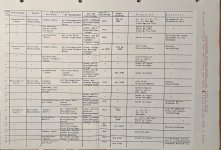
From the Larcade binder.
Table on the Prussian Kürassen.
-By Georg Petschke.
-including a remark by Mr. Larcade. [At the right side)..
 

Attachments

  • 20251231_164057.jpg
    20251231_164057.jpg
    411.8 KB · Views: 17
Back
Top