Indeed:
---The lithophane process (on a porcelain background) is not a determining factor, but some copies have a clearly identifiable design (a pair of figures).
---The decoration is always a vitrified decal on reproductions. The decoration is flat, with a uniform glaze. All copies of the same model are identical, even the names of the "Reservists." On authentic examples, there is a decal base, but it is highlighted with paint, and this highlighting is raised due to the thickness of the paint. For example, for the service period, the 19 is decaled, but the 02 and 04 are hand-painted, according to the exact year of service appropriate to the holder of the tankard. etc...
---The lid of authentic examples is made of pewter. It retains a shine on the inside. The copies are made of various alloys, containing zinc, lead, etc. The interior is anthracite and matte.
With a little experience, checking these three points is sufficient.
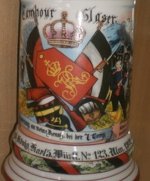
***Below, the yellow dots on the crown are in the decal, it's the copy.
View attachment 71242
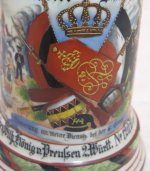
***Below, the yellow dots on the crown are raised, a drop of yellow paint, it is an authentic one that served as a model to reproduce.
View attachment 71241
The same applies to the lithophane:
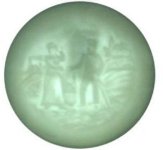
***The copy of the previous one:
View attachment 71243
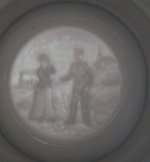
***The original :
View attachment 71244
Conclusion:
Since reproduction is defined as copying identically, one must be vigilant, informed, and well-documented because fakes can sometimes be quite formidable.