Original or repro steins

Hello everybody
I'm not sure if this would be the right place to post this, but I've been doing research on Regimental steins and such, however, I still find it difficult to tell if one is actually a period stein or a repro. If anybody can help me learn to distinguish them, it would be much appreciated. Thank you in advance.

Damien
 
A couple things I've learned is that repro steins usually have a tapered shape, wide at the bottom and tapering to a narrower top while originals are more even in size from the bottom to the top. Also, the lid should have mold seam marks, repros may not. That seems counter intuitive but is what I read. I'm sure there are other tells and someone more knowledgeable will confirm or correct what I have said and perhaps give more things to look at.

Lance
 
Hi Damien,

If you look closely, you will notice originals are hand painted it's pretty easy to see the difference especially with the writing of the names and regiments.

The texture and thickness of the paint on originals really stands out when compared to the printed smooth texture and look of the reproductions.

Hope this helps even if it's just a little bit.

MFG John Josef
 
Indeed:
---The lithophane process (on a porcelain background) is not a determining factor, but some copies have a clearly identifiable design (a pair of figures).

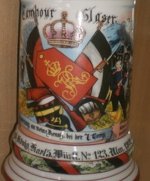
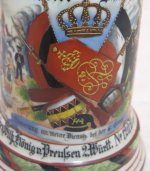
---The decoration is always a vitrified decal on reproductions. The decoration is flat, with a uniform glaze. All copies of the same model are identical, even the names of the "Reservists." On authentic examples, there is a decal base, but it is highlighted with paint, and this highlighting is raised due to the thickness of the paint. For example, for the service period, the 19 is decaled, but the 02 and 04 are hand-painted, according to the exact year of service appropriate to the holder of the tankard. etc...
---The lid of authentic examples is made of pewter. It retains a shine on the inside. The copies are made of various alloys, containing zinc, lead, etc. The interior is anthracite and matte.
With a little experience, checking these three points is sufficient.

I---The decoration
***Below, the yellow dots on the crown are in the decal, it's the copy.

123GR    FAKE.jpg


***Below, the yellow dots on the crown are raised, a drop of yellow paint, it is an authentic one that served as a model to reproduce.
126GR    BONNE.jpg


II --- The Lithophane :
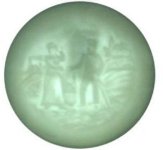
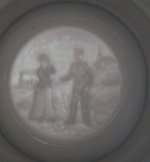
The same applies to the lithophane:

***The copy of the previous one:
Lithophanie  COPIE.jpg
***The original :
Lithophanie 0K.jpg

III --- The lid:
Couvercle  ETAIN 0K.jpg

The reverse of the copy lids are never shiny like here, but matte anthracite.

Conclusion:
Since reproduction is defined as copying identically, one must be vigilant, informed, and well-documented because fakes can sometimes be quite formidable.

 
Last edited:
Indeed:
---The lithophane process (on a porcelain background) is not a determining factor, but some copies have a clearly identifiable design (a pair of figures).

---The decoration is always a vitrified decal on reproductions. The decoration is flat, with a uniform glaze. All copies of the same model are identical, even the names of the "Reservists." On authentic examples, there is a decal base, but it is highlighted with paint, and this highlighting is raised due to the thickness of the paint. For example, for the service period, the 19 is decaled, but the 02 and 04 are hand-painted, according to the exact year of service appropriate to the holder of the tankard. etc...
---The lid of authentic examples is made of pewter. It retains a shine on the inside. The copies are made of various alloys, containing zinc, lead, etc. The interior is anthracite and matte.
With a little experience, checking these three points is sufficient.

***Below, the yellow dots on the crown are in the decal, it's the copy.

View attachment 71242


***Below, the yellow dots on the crown are raised, a drop of yellow paint, it is an authentic one that served as a model to reproduce.
View attachment 71241

The same applies to the lithophane:

***The copy of the previous one:
View attachment 71243
***The original :
View attachment 71244

Conclusion:
Since reproduction is defined as copying identically, one must be vigilant, informed, and well-documented because fakes can sometimes be quite formidable.

Thank you Clovis, this helps a bunch.
 
Hi Damien,

If you look closely, you will notice originals are hand painted it's pretty easy to see the difference especially with the writing of the names and regiments.

The texture and thickness of the paint on originals really stands out when compared to the printed smooth texture and look of the reproductions.

Hope this helps even if it's just a little bit.

MFG John Josef
Thank you, John
 
These are some great tips! I'll add a few that I am aware of:
  • "Sexy" or risque lithopanes are not period examples;
  • Originals generally have a smooth handle, while many reproductions have a finger bump on the inside of the handle; and
  • The hand-painted owner's name should always appear on the unit roster in the decal.
IMO, the biggest tell is the one Clovis mentioned above, which is the hand-painted details over the decal image. And as he indicated those details are generally dimensional - you can feel the little paint bumps on the surface.
 
Back
Top