SB3 Veterinarians helmet?

Hey All,

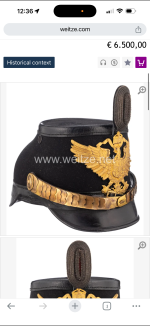
This pricy piece was listed on Weitze yesterday.
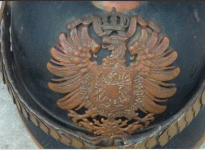
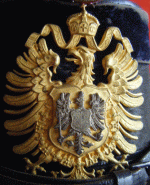
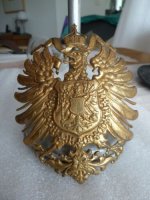
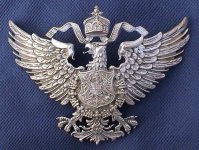
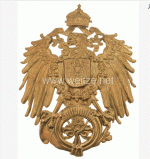
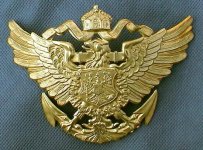
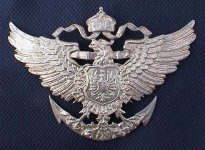
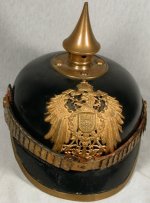
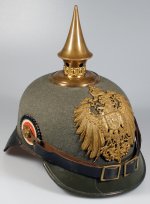
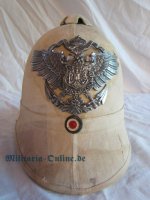
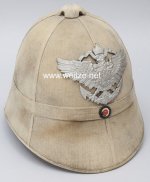
Interesting that there is no anchor behind the eagle. Anyone seen something like that before. Am I missing something though, what gives this away as being associated with the Third Seebataillon? To me it it a interesting helmet with an interesting story, but I don’t see any markings or even a name that can be referenced for service in Tsing Tao.


Anyone have thoughts?
Cheers
Jay
 

Attachments

  • IMG_1463.png
    IMG_1463.png
    1.7 MB · Views: 23
I would believe that if there's a period photograph. I wonder where did all these information originates from, it is certainly interesting.
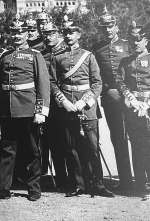
However, a number of weird things existed in Tsingtau. I have seen a photograph of what appears to be a veterinary officer wearing a Pickelhaube but fitted with a Seebataillon eagle helmet plate (with anchor).
 
Last edited:
Just my take/bit: I don't trust AI and their evaluation or historical context. For the price that is being asked, I would expect Mr. Weitze and his crew to have fetched more concrete data from say the BundesArchiv for this piece. Claims that were made in the description: If there were only two veteranary officers stationed in Tsingtau in 1914, what were their names? Obviously, you were able to assertain that.(Supposidly). from where is the source(s) on that? I really am skeptical of the story as it is currently presented.

From the Weitze website:
"Original pieces of such an eagle without anchor were previously unknown. The only known depiction of this eagle to us is found in a design for German colonial protection force uniforms, with personal annotations by Kaiser Wilhelm II. "

When were these created by the Kaiser? Were these officers already stationed in Tsingtau at the time of this regulation? These are just some of the questions I initially thought of. So, where is the M.O.bl or M.V.bl that states that Veteranarian officers stationed in overseas colonies (specifically China) were approved to wear this wappen? So, much to unpack here.....

"This unusual variant can be explained by the specific uniform regulations for veterinary officers in the III. Seebataillon. According to regulations, these officers were to wear the “White Uniform” and “Tropical Uniform” in summer, like the officers of the naval field artillery battery. In winter, however, the army uniform with pickelhaube was prescribed, though with the Reich eagle rather than the Landwehr eagle. Officers of the naval field artillery battery, by contrast, wore the blue uniform of the naval battalion year-round with the shako and the special naval eagle."

So where is this? Too vague a response.

"It appears plausible that in practice, the veterinary officers oriented themselves toward the officers of the naval field artillery and also wore a shako instead of the pickelhaube. However, to clarify their special status as officers not originally belonging to the navy, the eagle was manufactured without the anchor. This solution was a compromise: the shako and naval eagle showed membership in the III. Seebataillon, while the absence of the anchor indicated the veterinary officers' army status."

At least AI has stated that this is a plausible theory, but again showing that it is speculation. This again, shows that the price is reflecting the plausible hypothesis and highest valuation of being true. But it could not be.....
Seems to me there might be some negotiation room if someone was to be interested in purchasing.

So, IMHO, The seller needs to produce this researched information. I personally never heard about this? This is being sold as a "Extremely Rare"... Obviously, with the hefty price tag. So, I believe that the seller needs to produce more concrete proof and not just the hearsay of any AI model. If the seller doesn't want or have the time to do this, I sure hope the perspective buyer takes the time to research and difinitively prove this "extremely rare" piece and accept that this piece and it's hefty Pricetag.

Ultimately, it is up to the buyer to either believe the story or to not believe the story and the price.

"Believe the item, not the story. " The best mantra to follow in the collecting world.
Thank you for reading my nonsensical babblings.
Best Regards,
JustinG

On a side note, I have had many very favorable dealings and speak very highly of Weitze and his staff. They are consumate professionals.

 
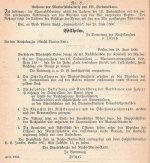
This from the Marine-Verordnungsblatt Nr. 16 of 1900.

It stipulates that the then veterinary officials (Beamten) wore the uniform of the veterinary officials of the army but as detailed in paragraph 5, the Reichsadler. Presumably continued when the veterinarians became officers in 1910, although the 1911 Bekleidungsvorschrift does not explicitly mention officers attached to the naval infantry.

Regards
Glenn

Mar.Feldbatt..jpg
 
Here is the photo of that mysterious helmet I mentioned in my previous post. On the left a veterinarian in proper uniform is also clearly visible, his helmet is in accordance with the regulations — Reichsadler plate.

View attachment 73618
Thank you very much for this incredible photo!

May I ask a question? What kind of helmet is the second officer from the right wearing? I’ve never seen anything like it before. The Sea Battalion eagle on a standard Pickelhaube — unbelievable.

Since I’m not at all familiar with colonial pieces, the only thing I can add to this discussion is that I’ve seen the Sea Batallion shako for an officer without the anchor offered at another auction a while ago. Maybe the same pice. Perhaps I can still find the photo.

Best wishes,

GardeUlan
 
May I ask a question? What kind of helmet is the second officer from the right wearing? I’ve never seen anything like it before. The Sea Battalion eagle on a standard Pickelhaube — unbelievable.
As for now unknown. The only other known Pickelhaube with a SB plate I've seen was worn by the last king of Saxony, but that one had a square visor. The reason was also unclear, probably a special distinction.
 
Gr
Here is the photo of that mysterious helmet I mentioned in my previous post. On the left a veterinarian in proper uniform is also clearly visible, his helmet is in accordance with the regulations — Reichsadler plate.

Great photo, thank you for sharing. Very interesting variation. I wonder if it still exists somewhere out there.

I did find this photo on facebook from the colonial empire group featuring a SB eagle also missing its anchor. So it must have been a thing.

As for the one up on Weitze, it does appear to have been sold on a non military specific auction site back in 2022.

Cheers
 

Attachments

  • IMG_1606.jpeg
    IMG_1606.jpeg
    293.9 KB · Views: 22
  • IMG_1607.jpeg
    IMG_1607.jpeg
    198.7 KB · Views: 22
Hello,
I think it's time to summarize the Reichsadler:

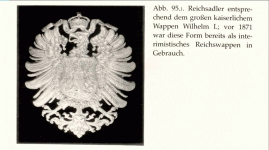
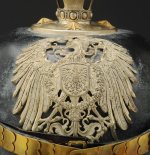
1---Reichsadler Wilhelm I : The feathers on the wings are upturned.
Infra, The imperial crown has been replaced by the royal crown. I don't know why.
Prusse Gend type Wilhelm I.GIF
Infra, Here is a Reichsgendarm shako, for Alsace-Lorraine, under the reign of William I.
Reichsgend Wilhelm Ier.GIF
Reichsadler W1 71 à 88 150€EB22.jpg
1871-1888 :
Reichsadler W I 1871à1888.GIF
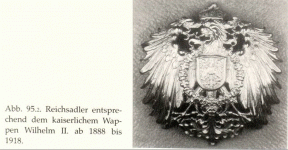
2--- Reichsadler Wilhelm II : This time the feathers from the wings fall back down.
Used only for the Reichsgendarm and imperial military administrations, but also for soldiers and officers of the expeditionary force in Southeast Asia.
Silver-plated nickel silver for civil servants and police, gold-plated brass for military personnel.
Reichsadler 0ff Chine PB.JPG
1888-1918 :
Reichsadler W II 1888à1918.GIF

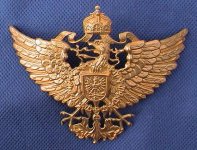
3---Reichsadler for Schutztruppen South-West-Africa and Askari Tarbusch... : Like the previous ones, imperial crown, banner, but this time the wings are soaring.
Kaiser_Colo Pol.jpg
Kaiser_Colo SWA.jpg


4---Reichspostadler Wilhelm II : A hunting horn is added to the tail

Reichsadler Post-Amt 250€.GIF

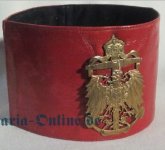
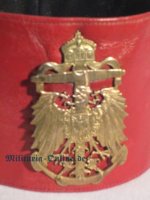
5---Kaiserlische Marine ou See-Bataillons : A marine anchor is added
Kaiser_ Marine.jpg

Kaiser_   Marine.jpg
In summary, eagles that resemble each other with the same imperial crown, and the central coat of arms of the Hohenzollern family, but each with its own specific destination!
 
Some hairstyles:


-----Colonies of the Empire and Reichsland Alsace-Lorraine :
Reichsgendarm type Kammer95.jpg
BA0 PHcom.jpgBortfeldt Shako OstAsiatisch_.jpgTroppenhelm Diplomat.GIF


---Kaiserlische Marine and See-Bataillon :
Seebat.jpgSeeB.Korkh.  3200€2015.jpgMar.Wacht -meister.JPGMarine  Wachtm..jpg
Same as above, but with an anchor.
In the case of a veterinarian with a Reichsadler without an anchor, it means Imperial Veterinarian. The "Navy" aspect is not taken into account.
 
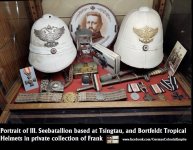
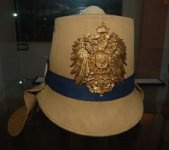
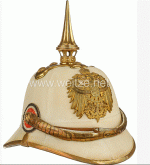
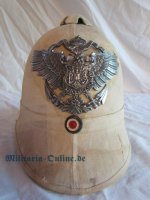
Very concise! Wonderfully done. Thank you. Would you think the image I posted above of the two sun helmets features an African Schutztruppe eagle?

Cheers
Yes !
Here is a Bortfeldt for Asia
BAO Trop Ratisbon.jpgSchutztruppen Asia.GIF
Same eagle as for the Reichsland, drooping feathers, lowered wings.

So, in theory:
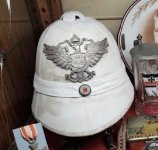
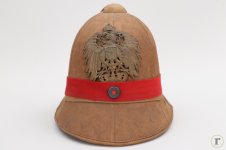
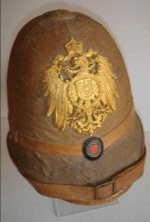
---The helmet on the left, a silver Reichsadler with outstretched wings and no naval anchor, represents a diplomatic or military official serving in the African colonies.

---The helmet on the right, a gold or silver Reichsadler with outstretched wings and a naval anchor, represents a marine trooper – See-Bataillon.
Seebat.jpg
 
Last edited:
So maybe, the Weitze SB shako minus the anchor from the start of this post is some sort of home worn or administrative African officer? I still don’t see any connection there to Tsingtao.
 
Gr


Great photo, thank you for sharing. Very interesting variation. I wonder if it still exists somewhere out there.

I did find this photo on facebook from the colonial empire group featuring a SB eagle also missing its anchor. So it must have been a thing.

As for the one up on Weitze, it does appear to have been sold on a non military specific auction site back in 2022.

Cheers
Yes, it was in September 2022 and it‘s the same piece. Here’s a link to the catalog. It‘s lot 796. In the description the auction house stated that the anchor tips were removed.

Best wishes,

GardeUlan

https://cdn.website-editor.net/s/82ee1e2954794ed18654f2ff08d3f01b/files/uploaded/Katalog15.pdf?Expires=1773997018&Signature=iWgJHMYqH3krENxn5KBiMeZ8d2kSWStd2lRM2OL4hVyMTg4P3roQX9QPQhlrO2DB0X7ItSvl8h8VsZADtIcZh68-mUp1G9FKPhuRpBz3XimllH-Hi06Zj6STbcSgMvWhK-lQcRk6Yk5KlqNPQW2JL28HdE50Djl3EuXa46xcSPmTERHvKYj-Sqb3GdtQunFWKO6~SPvwI0n0rnyKo613DbB9QDTiPlSsAM1CF4EyS4QP1-3KPgBqGpOZDYioMUcM2OM4pP1t6S-HsDJ5EYvxmpsMpWixcOionh~Qpr68wv6BXHfH2OGRCbwjIR9zu6DR-QP-iz7K1Pn15rrQY5~2vw__&Key-Pair-Id=K2NXBXLF010TJW


LOS 796

Kaiserliches Seebataillon Tschako für Offiziere, Preussen, Königreich Preussen, Lackledertschako für Offiziere Seebataillon, mit kaiserlicher Adler (Ankerspitzen an beiden Seiten entfernt), Reichskokarde und flacher Messing - Schuppenkette, innen Lederfutter, Gr. ca. 54, H 14,5 cm x B 15,5 cm x T 25 cm,
Altersspuren, Naht des Innenfutters löst sich


LOT 796
Imperial Naval Battalion shako for officers,
Prussia, Kingdom of Prussia. Black patent leather shako for Naval Battalion officers, with imperial eagle (anchor tips on both sides removed), imperial cockade and flat brass chin scale chain. Interior leather lining, size approx. 54.
Height 14.5 cm x Width 15.5 cm x Depth 25 cm.
Signs of age, stitching of the inner lining is coming loose.
 
Two points to note:
---1 This Reichsadler with gliding wings did exist, without the anchor.
---2 If it had been a naval eagle, cutting out the anchor would leave marks, especially since the tail is stamped onto the anchor. Therefore, simply removing the two arrows on either side, and also the bar between the neck and the wings, is not enough!

And one observation: I've never seen a black shako or a black leather spiked helmet used in the "hot" colonies. Only "troppenhelms," or colonial headdresses for hot climates. Whether it's Southeast Asia, Southwest Africa, or the Balkans-Macedonia, these are always headdresses specifically designed for hot climates. It's impossible to wear such a headdress in direct sunlight, in 50°C heat, without fainting.
This could then be a traditional officer's shako or uniform for a former officer or administrator with officer rank who was serving in the colonies (but not worn in hot countries).
 
Back
Top